

Artificial Graphite
Artificial graphite is fabricated by heat treatment of petroleum coke, coal-tar pitch, or oil. Artificial graphite is a highly durable material, and is used in a wide range of applications, including PC and smartphone devices, and lithium-ion secondary batteries for electric vehicles, whose market is expected to grow significantly in the future.
Why Choose Us?
Strict Quality Control
Qitian Products ensure 100% of all graphite petroleum coke meet industry quality standards and passed final inspection and then are carefully packaged for delivery.
Stable Supply Capacity
We have our own production plant, with a daily shipment of up to 100 tons. We have advanced technicians to help us improve production technology and production efficiency.
Professional Management System
The company's system is very complete. From the early stage of customer docking to the later stage of product sales, we can use professional software management to improve efficiency.
24 Hours Service
We can provide the best export service and after-sales service. 24 hours on line for help.


Advantages of Artificial Graphite
Electrochemical performance
Compared with natural graphite, artificial graphite can not only control its quality and structure more strictly but also have better electrochemical performance. As a common battery material, graphite has always been favored. However, with the continuous advancement of science and technology, people can crush natural graphite and then process artificial graphite through chemical or physical processes. Therefore, as a battery material, it has a wide range of application prospects and is known as a very potential alternative material.
Custom Design
It can also adjust the structure and morphology to achieve customized design to meet the performance requirements of different application scenarios. For example, by finely controlling its microstructure, it can become different kinds of battery materials such as supercapacitors, energy storage materials, and lithium-ion batteries. This property makes artificial graphite a hot topic in the field of battery materials research.
High electrical conductivity
It is a material made of natural graphite, which changes its crystal structure through high-temperature sintering to form a material with high conductivity, high-temperature stability, and high structural controllability. It is widely used in many fields, but the most commonly used is in batteries. Artificial graphite in modern batteries is mainly used on negative plates to store and release ions in the negative electrode, which generates an electric current. Compared to natural graphite, it is purer, has higher conductivity, and has a more homogeneous structure, which improves battery performance and life.
Types of Artificial Graphite


Fine-grain graphite
Some special property combinations of graphite can only be obtained if fine-grained solids are used. Therefore, the so-called fine-grain graphite was developed, which is produced by a grinding process. Fine-grain graphite is graphite with a grain size of less than 1 mm. Some fine-grain graphite even has a grain size of less than 1 µm.
Isostatic graphite
The term "Isostatic graphite" stands for isostatically formed graphite. This means that the raw material mixture is compacted into rectangular or round blocks in a so-called cold-isostatic press (CIP). Compared to other techniques such as extrusion or vibration molding, this technology can produce the most isotropic form of artificial graphite. In addition, isostatic graphite generally has the smallest grain sizes of all artificial graphite.
Extruded Graphite
Extruded graphite is produced by extrusion. Compared to isostatic graphite, it has a coarser grain size and lower strength, but higher thermal and electrical conductivity.
Vibration Molded Graphite
Vibration molded graphite is characterized by a homogeneous structure and typically a medium grain size. The material has a planar isotropic, i.e. almost isotropic property profile and can be produced in very large formats.
Die-molded graphite
The material class of die-molded carbon and graphite includes various materials such as amorphous carbon, graphite and the so-called carbon graphite, a composite of hard carbon and graphite. These materials have a fine to ultra-fine grain size and can also exhibit a high anisotropy due to the axial forming process. This variety of materials results in an extremely wide range of property profiles in terms of strength, frictional behavior and conductivity.
Artificial Graphite Use in the Aerospace Industry
Thermal Management Systems
Artificial graphite is known for its excellent thermal conductivity. In aerospace applications, it is used in the construction of heat sinks and thermal management systems. These components help dissipate heat generated by electronic equipment and propulsion systems, ensuring that critical aerospace systems operate within safe temperature limits.
Electrodes for EDM (Electrical Discharge Machining)
Electrical discharge machining is a precision machining process used in aerospace manufacturing. artificial graphite electrodes are used in EDM machines to create complex shapes and features in aerospace components made of hard materials such as titanium and nickel alloys.
Aviation Brake Systems
Artificial graphite composites are employed in aircraft brake systems due to their high thermal conductivity, low wear rates, and high strength. These materials can withstand the extreme temperatures and forces generated during aircraft landings and provide reliable braking performance.
Aircraft Structural Components
In some cases, artificial graphite composites are used in the construction of lightweight structural components in aircraft, particularly in applications where high strength-to-weight ratios are critical.
Fuel Cells
Artificial graphite is used as a component in aerospace fuel cell systems, which are being explored as a potential alternative to traditional combustion engines that rely on fossil fuels. Fuel cells generate electricity through electrochemical reactions and require materials like artificial graphite for their electrodes and bipolar plates.
Spacecraft Components
In space applications, where extreme temperatures and vacuum conditions are encountered, artificial graphite is used in various components, including satellite thermal shields, rocket nozzle throats, and payload structures.
Ion Thrusters
Artificial graphite is used in ion thrusters, a type of propulsion system used in spacecraft for long-duration missions. These thrusters rely on the acceleration of ions (usually xenon) to generate thrust and require artificial graphite grids or similar components.
Electrical Contacts
Artificial graphite is used in electrical contacts and brushes in aerospace systems where precise electrical conductivity and wear resistance are important, such as in control systems and avionics.
Reinforcements in Composites
Artificial graphite fibers are sometimes used as reinforcements in composite materials for aerospace applications. These composites can be used in aircraft components to reduce weight while maintaining strength and durability.
Radiation Shielding
In space missions, artificial graphite composites may be used for radiation shielding to protect astronauts and sensitive equipment from cosmic radiation.
Structure and Properties of Artificial Graphite
Electrical conductivity of artificial graphite
The fact that artificial graphite is electrically conductive results from its atomic structure. Each carbon atom in a artificial graphite crystal has four valence electrons, also called outer electrons, which can form bonds with neighboring atoms. However, only three of the four valence electrons enter into a bond, while the fourth electron remains freely mobile and thus allows electricity to be conducted.
Thermal conductivity of artificial graphite
Artificial graphite has excellent thermal conductivity combined with high temperature resistance. artificial graphite does not have a melting point; it changes from the solid state directly into the gaseous state. This process is called sublimation. In an inert gas atmosphere, artificial graphite becomes plastically deformable starting at a temperature of 2500 °C. At temperatures above 3750 °C artificial graphite sublimates even without the presence of oxygen.
Chemical resistance of artificial graphite
Artificial graphite is one of the most chemically resistant materials. It is resistant to almost all media of organic chemistry. These typically include the intermediate and/or end products in the petrochemicals, coal refining, plastics industry, the production of paints, coatings, refrigerants and antifreeze, but also in the cosmetics and food industries. artificial graphite is also resistant to most inorganic media, such as non-oxidizing acids, alkalis, aqueous salt solutions and most technical gases.
Artificial Graphite’s Essential Function in Lithium-Ion Batteries
Artificial Graphite Has Great Conductive Materials
Artificial graphite is an excellent conductor of electricity and heat. This makes it ideal for use in batteries, where it helps to efficiently conduct electrons between the anode and cathode. Artificial graphite is also highly resistant to corrosion, which is important for lithium-ion battery longevity.
Artificial Graphite Enhances Battery Cycle Life
One of the most important performance metrics for batteries is cycle life, or the number of times a battery can be discharged and recharged before it needs to be replaced. Artificial graphite plays a key role in enhancing battery cycle life, by helping to prevent lithium ions from becoming trapped in the anode during charging.
Excellent High-Capacity Rate
Artificial graphite also has a high-capacity rate, meaning it can store and release large amounts of energy quickly. This is important for applications like electric vehicles, where the battery needs to be able to discharge a large amount of power rapidly. Eco-friendly process cycle for artificial graphite is a superior choice to meet lithium-ion battery grade standards for optimal performance and energy production.
Natural Vs. Artificial Graphite
Composition
Artificial Graphite: Produced from a carbonaceous feedstock through high-temperature processing, artificial graphite exhibits a highly ordered atomic structure. It boasts a purity level exceeding 99% carbon, with the remaining impurities mainly comprising ash and volatile materials.
Natural Graphite: Derived from naturally occurring mineral deposits, natural graphite is formed through the metamorphism of organic material. It consists of varying carbon content, typically ranging from 15% to 95%, with the remaining composition comprising impurities such as ash, sulfur, and trace elements.
Manufacturing Processes
Artificial Graphite: The production of artificial graphite involves graphitizing carbonaceous materials, such as petroleum coke or coal tar pitch, at temperatures exceeding 2,500°C. This process enables the alignment of carbon atoms, resulting in a highly crystalline structure with excellent thermal and electrical conductivity.
Natural Graphite: Extracted from mines or quarries, natural graphite undergoes several mechanical and chemical treatments to enhance its quality. These processes include milling, flotation, purification, and micronization, allowing for removing impurities and adjusting particle size and distribution.
Physical and Chemical Properties
Artificial Graphite: Artificial graphite possesses superior physical properties compared to its natural counterpart. It exhibits high density, low porosity, and remarkable thermal and electrical conductivity. Additionally, artificial graphite offers excellent resistance to chemical corrosion, making it suitable for demanding applications.
Natural Graphite: Natural graphite exhibits lower density, higher porosity, and moderate thermal and electrical conductivity. Its properties can vary depending on the origin and processing techniques employed. While it may not have the same performance level as artificial graphite, natural graphite still finds wide application in various industries.
Applications
Artificial Graphite: Owing to its exceptional properties, artificial graphite finds extensive utilization in advanced industries. It is an essential component in lithium-ion batteries, enhancing their energy density and extending their lifespan. artificial graphite is also utilized in high-temperature applications like crucibles, electrodes, and heating elements.
Natural Graphite: Natural graphite finds application in diverse sectors. It is commonly used as a lubricant due to its self-lubricating properties. Additionally, natural graphite is employed in the steel and automotive industries for crucibles, foundry coatings, brake linings, and gaskets. It also serves as an anode material in alkaline batteries and in nuclear reactors as a moderator.
Manufacturing Process of Artificial Graphite
Powder and paste preparation
Raw materials for artificial graphite fabrication (petroleum coke, pitch coke, carbon black, natural graphite and secondary graphite scrap are loaded and stored in raw material silos. First, the raw materials are ground in crushers and ball mills. The resulting powder is then conditioned according to the particle size distribution. Finally, the powder is blended with a binder to produce a paste. Coal tar pitch or petroleum pitch are used as binders.
Shape forming
The resulting pasty mixture may be compacted using one of the shape forming techniques: extrusion, vibro-molding or cold isostatic pressing.
● Extrusion consists in forcing the pasty mixture through a die with an opening. Extrusion results in a long product such as rods, bars, long plates, or tubes with regular cross-sections, which may be cut into pieces of the required length. Extruded graphite materials are isotropic. The properties in the extrusion direction differ from the properties in other directions.
● Vibration molding is a discontinuous shaping method for products with large dimensions. A mold is filled with the pasty mixture and a heavy metal plate is put on top of it. Then the material is compacted by vibrating the mold. The formed bodies show a higher degree of isotropy compared to extruded materials.
● Cold isostatic pressing is the powder compaction method conducted at room temperature and involving applying pressure from multiple directions through a liquid medium surrounding the compacted part. A flexible mold immersed in a pressurized liquid medium is used. Materials with uniform anisotropic structure are prepared using the isostatic pressing method.
Baking
The compacted parts are heat treated in an anaerobic baking furnace at temperatures between 900 and 1200°C (1650 and 2200°F). Carbonization occurs during baking. It results in the thermal decomposition of the binder into elemental carbon and volatile components. Carbon formed in the carbonization process binds the powder particles. The volume of the binder is higher than the volume of the formed carbon. Therefore, carbonization results in the formation of pores. The total relative volume of porosity is determined by the binder quantity.
Pitch impregnation
At this point in the process the carbon parts may be impregnated with pitch and re-baked to reduce its porosity. Impregnation is typically performed using a pitch lower in viscosity than the original binder pitch. Low viscosity is required in order to fill gaps more completely. Petroleum pitch is normally utilized for this function. For some high-density graphite grades, the carbon parts may go through the baking, pitch impregnation, rebaking cycle several times.
Graphitization
At this stage the shaped, baked, pitch impregnated, and rebaked parts are heat treated in an anaerobic environment at an extremely high temperature of 2700 to 3000°C (4900 to 5450°F). Graphitization results in the crystallization of amorphous precursor carbon, which transforms into crystalline graphite. Under the influence of temperature, the crystallites grow and rearrange in an ordered pattern of stacked parallel planes. This transformation is accompanied by a change in the physical properties of the material. During this high temperature treatment graphite is also purified since most of its impurities (binder residues, gases, oxides, sulfur) vaporize.
Quality checks
The graphitized articles go through a series of tests and inspections before being shipped. At this stage, the resulting graphite material already has excellent corrosion resistance and outstanding thermal conductivity. However, it is highly porous and therefore not at all impervious.
Our Factory
The company now has 2 modern production workshops and 2 large storage workshops, which can meet the needs of large-scale production and fast logistics. The annual production volume has reached 100,000 tons. After years of hard work, we have worked closely with many domestic companies and exported to many countries and regions. In the future, the company will continue to adhere to the business philosophy of "quality-oriented, honesty and trustworthiness", continuously improve product quality and service level, carry out extensive cooperation and exchanges with domestic and foreign companies, and jointly promote the development of the carbon industry.

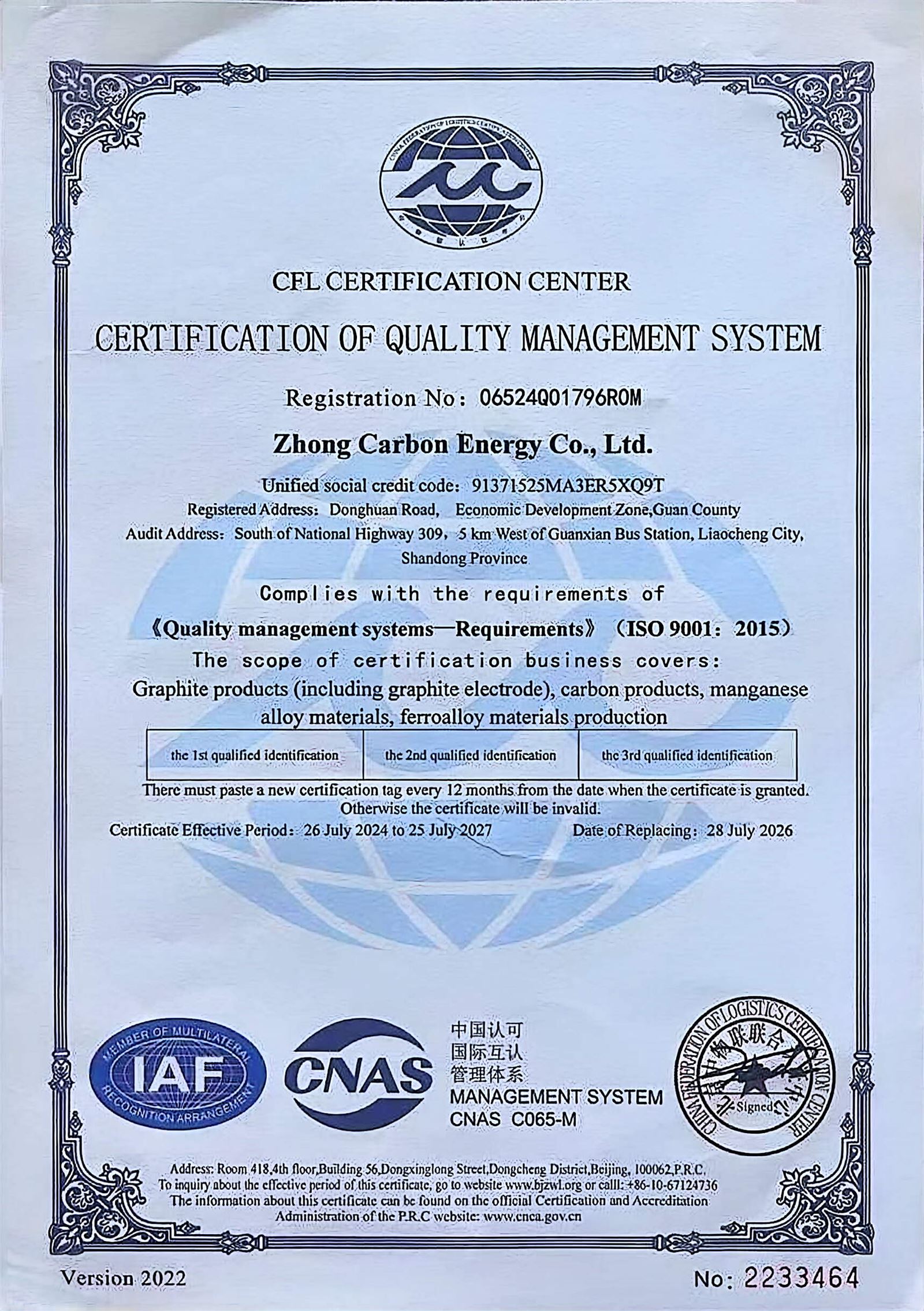
Our Certifications
FAQ
Q: What is artificial graphite?
Q: What do you need to know about graphite?
Q: What are the raw materials for artificial graphite?
Q: Is synthetic graphite expensive?
Q: What are the negative effects of graphite?
Q: What are some interesting facts about graphite?
Q: What is unusual about graphite?
Q: How much does synthetic graphite sell for?
Q: What is the main difference between natural and artificial graphite?
Q: What are the typical applications of artificial graphite?
Q: What are the advantages of using artificial graphite over natural graphite?
Q: How is the manufacturing process of artificial graphite different from that of natural graphite?
Q: What are the key properties that make artificial graphite useful in various applications?
Q: How does the purity of artificial graphite compare to natural graphite?
Q: Can artificial graphite be recycled or reused?
Q: What are the environmental considerations in the production of artificial graphite?
As one of the most professional artificial graphite manufacturers and suppliers in China, we're featured by quality products and good price. Please rest assured to buy artificial graphite for sale here from our factory.