

Graphite Granular
Graphite granular, also known as expanded graphite or exfoliated graphite, is a specialized form of graphite that has been processed to create a porous, lightweight, and highly conductive material. Graphite granular offers a unique combination of properties, including high thermal and electrical conductivity, low density, and excellent insulation characteristics, making it a versatile material for a wide range of applications in various industries.
Why Choose Us?
Strict Quality Control
Qitian Products ensure 100% of all graphite petroleum coke meet industry quality standards and passed final inspection and then are carefully packaged for delivery.
Stable Supply Capacity
We have our own production plant, with a daily shipment of up to 100 tons. We have advanced technicians to help us improve production technology and production efficiency.
Professional Management System
The company's system is very complete. From the early stage of customer docking to the later stage of product sales, we can use professional software management to improve efficiency.
24 Hours Service
We can provide the best export service and after-sales service. 24 hours on line for help.


Advantages of Graphite Granular
Has good thermal conductivity and electrical conductivity
The electrical conductivity of graphite granular is good. Although it cannot be compared with metals such as aluminum, iron, and copper, its electrical conductivity is quite high compared with other common materials, three times that of carbon steel and five times that of stainless steel. Metal materials are 100 times higher. It has a high temperature under super thermal insulation performance, and it is usually different from metal materials. Generally, the thermal conductivity of metals increases with the increase of temperature. graphite granular tends to be adiabatic at extremely high temperatures.
With super high-temperature resistance
Generally, when the material exceeds 2000 °C, gas is generally generated in the molten state, but the graphite granular does not melt, and its melting point is about 3900 °C, and the boiling point of 4250 °C. The loss of ultra-high temperature graphite granular is very low.
Good lubricity
The friction coefficient of graphite granular can be less than 0.1, and the performance of the lubrication system varies with the size of the flakes. The larger the flakes, the smaller the friction correlation coefficient and the better the performance of the lubricating material.
Excellent thermal shock resistance
Graphite granular has good thermal shock resistance. When the temperature changes suddenly, its thermal expansion coefficient is small, and its good thermal stability makes its graphite-related products not crack.
Good chemical stability
At room temperature, graphite has excellent chemical stability and is resistant to acid, alkali and organic solvent corrosion.
Application of Graphite Granular
Lubrication
Due to its low friction properties, graphite granular is used as a dry lubricant in various mechanical applications, especially in situations where oil or grease-based lubricants are not ideal. It's used in locks, hinges, and even in manufacturing processes to reduce friction between moving parts.
Reinforcement in Materials
In the manufacturing sector, graphite granular is often added to materials like plastics, rubber, and metals to enhance their properties. For instance, it can improve the conductivity of plastic and rubber products or reinforce materials used in making batteries.
Heat and Chemical Resistance
Graphite granular is used in high-temperature applications such as in the making of crucibles, molds, and foundry facings due to its resistance to heat and chemical reactions.
Art and Industry
Artists use graphite granular in drawing, particularly for creating shading effects. In industry, it's used in pencils and as a component in paints and coatings.
Electronics
Graphite granular is utilized in the production of electrodes and batteries due to its conductivity.
Thermal Management
In electronics and other industries, graphite granular is used in thermal management applications, like in thermal pastes or pads to conduct heat away from sensitive components.
Physical Properties of Graphite Granular


Color and Appearance
Graphite granular’s color varies from a shiny metal look to a dark gray shade. Its unique look makes it more attractive and easy to spot in different uses. This unique color is great for pencils, making pictures and drawings look more profound and more exciting.
Density and Specific Gravity
Even though it’s strong, graphite granular is surprisingly light. Its many layers and open rooms let it stay on top in water. It also feels as light as a feather when you touch it. Because it’s not heavy, it is perfect for uses where weight is essential, such as airplane pieces and sports gear.
Melting and Boiling Points
Though graphite granular is excellent at carrying heat, it needs 3,500°C to turn soft and become liquid. This high melting point is excellent for hot uses like things made in a foundry and even parts of nuclear reactors. Think about having a pencil in a volcano, that’s how hot graphite granular can get.
Conductivity (Electrical and Thermal)
Graphite granular’s ability to conduct electricity and heat are closely related. The moving electrons in its layers easily share both heat and electricity.
Lubrication Properties
Graphite granular’s layers let it move easily between the layers, making it an excellent lubricant. This makes it popular in cases where less slip and smooth movement are important. This makes it great for locks, wheels, and even pencils.
Crystal Structure of Graphite Granular
Hexagonal Lattice Arrangement
Graphite granular’s carbon atoms line up in a hexagonal pattern within flat layers. This makes the structure beautiful and strong. This setup helps make graphite granular special, like its ability to conduct electricity and slippery properties.
Layers and Intermolecular Forces
The graphite granular sheets, like stacked pieces, have amazing bendy strength and movement because weak connections between molecules hold them together. These forces help the layers to move easily one over another. This makes graphite granular act in a unique way, which can be used across different businesses
Chemical Properties of Graphite Granular
Reactivity with Oxygen
Graphite granular, a usually calm part of the chemical world, can get into trouble with oxygen when things are hot. When hotter than 700 degrees, this material peels off in layers and turns into carbon dioxide. This helps to feed fires and power big furnaces that melt things. This feature strengthens the material and lasts in different places, especially around the air.
Resistance to Acids and Bases
Its strong carbon-carbon bonds and layered structure are hard to break by most acids and bases. This makes it perfect for uses like the inner walls of chemical reactors and even containers that can handle hot metals. This feature makes it better in harmful places, which helps to use more types of things.
Oxidation and Corrosion
Graphite granular changes a lot when it gets very hot, but usually, at standard conditions, this change is slow and steady. It slowly rusts or wears down over time. As time goes by, oxygen around it gradually creates a thin layer of carbon dioxide on its surface. This slow wearing down doesn’t change its main features, making it a strong and trustworthy material.
What Is the Process of Making Graphite Granular?
In the first stage – Oxidized natural graphite stage
You put a certain amount of graphite into the H2O2 solution and use a stirrer to disperse it completely for 5 minutes. After stirring, let the dispersed system stable for 6 hours and put it in the thermostatic cabinet at room temperature. Next step, you will wash the oxidized graphite with pure water and dry the graphite at the temperature of 60 degrees Celcius for 4 hours to collect oxidized graphite.
In the second stage – Intercalated stage
You will prepare the reaction solution by adding an amount of potassium permanganate (KMnO4) into perchloric acid (HClO4) solution and stirring it for 2 minutes. Next, you will put the amount of oxidized graphite collected into the solution and stir it for 5 minutes to make sure that graphite is dispersed equally in the solution.
After that, the solution will be put in a hot-water boiler at the temperature of 40 degrees Celcius, and the reaction will happen in 30 minutes. After 30 minutes, you will add some amount of acid acetic to the solution and let it continue to react for another 30 minutes under the same condition. Then, you will wash the product with pure water again until the filtrate is clear and has a pH of 5 to 7.
In the end, you will collect the graphite granular as you wish after drying it for 4 hours at the temperature of 60 degrees Celcius.
What Is the Melting Point of Graphite Granular?
Melting point, or what you can call liquefied temperature, means that when you heat a substance until a certain temperature, it will undergo a melting process and change form from solid to liquid.
Nowadays, graphite granular is known as one of the highest melting points. The temperature to melt graphite granular is approximately 3650°C nearly as high as diamond.
If you use the Fahrenheit scale, graphite granular has a melting point of approximately 6602°F. And about 3948°K if you care about the Kelvin scale. This converse information is very important in many fields and industries that have applications related to the Fahrenheit scale or the Kelvin scale to measure temperature.
There is an interesting fact about the melting point of graphite granular that you should know. graphite granular does not exist in the liquid form under normal conditions.
When the temperature increases, graphite granular will sublimate directly from solid form to gaseous without changing to liquid form. However, when you put graphite granular under very high pressure, it can convert to liquid form but this does not happen under normal conditions.
You may wonder why it does not liquefy. Well, this is due to its special structure of graphite granular with layers of Carbon arranged in a hexagonal pattern. This structure is extremely durable so it will not melt in a normal way but change directly to gaseous at a high temperature.
And there is one thing that you should notice about graphite granular, it has a melting point but its boiling point is unclear because it does not liquefy.
What Affects Graphite Granular’s Melting Point
Pressure
When you increase the pressure, the melting point of graphite granular also increases as well. This means under high pressure, graphite granular needs a higher temperature to change form from solid to liquid.
01
Impurities
Impurities in graphite granular may change the melting temperature. They can make the crystal structure of graphite granular become disordered, causing it to melt at a different temperature when compared to the purity of graphite granular.
02
Roughness surface
The surface of graphite granular, whether smooth or rough, can influence the way it handles heat. If graphite granular has a rough surface, it can process heat less efficiently and affect the melting point.
03
Heating temperature
The rate at which the temperature is raised can affect how graphite granular melts. If you increase the temperature too fast, it can lead to the decomposition of graphite granular before it has a chance to sublimate. In converse, when you gradually heat, graphite granular can be sublimated effectively.
04
Thermal Properties of Graphite Granular
Graphite Granular Coefficient of Thermal Expansion
You will find graphite granular has a very low coefficient of thermal expansion (CTE). In layman’s terms, you are bound to expand any material when you apply some form of heat to it. The reason graphite granular’s CTE is low is that it will only expand slightly even in extreme temperature conditions. This comes in handy in applications high-temperature applications having components fabricated using graphite granular. Such components include molds, tools used to manufacture or process glass, and many other furnace components.
Graphite Granular Resistance to Thermal Shock
We can define graphite granular’s resistance to thermal shock as the factor that enables it to retain its structure when exposed to various thermal conditions. We can safely assume that graphite granular has one of the best resistances to thermal shock. It can achieve this based on traits such as its low coefficient of thermal friction (CTF) and its exceptional high strength. Another factor that greatly aids its resistance to thermal shock is its low modulus of elasticity.
Melting Point of graphite granular
Graphite granular has a very strange behavior unlike other elements when you expose it to its melting point. Once it reaches its melting point, it will start subliming instead of melting. This melting point is usually 3600°C, an extreme melting temperature that borders around the melting point of the diamond. When we look at the structural properties of graphite granular, they are inferior to common metals. However, graphite granular becomes stronger when you expose it to temperature variations of between 1000 to 2500°C. This shows you that such temperatures enhance your graphite granular’s structural strength.
Graphite Granular Thermal Conductivity
The thermal conductivity of graphite granular is simply its ability to transfer or dissipate heat. Due to its impressive heat transfer qualities, you will experience high levels of thermal conductivity when using graphite granular. You will find the thermal conductivity of common graphite granular materials ranging between 110 to 240 W/(mK). This can go as high as between 1000 to 2000 W/(mK) depending on the various graphite granular composites. You can apply such materials in processes that require constant heat dissipation. You can achieve this through the use of graphite granular heat sinks and heat exchangers.
Graphite Granular Resistance to Cryogenic Temperature
Let us begin by first describing what cryogenic temperatures are. These are application temperatures that range between -50°C and absolute zero (-273°C). When spacecraft reach space, they experience subzero temperature environments. This means that you cannot use just any seal or lubricant in such applications. As we already know, graphite granular is self-lubricating. This means that they cannot solidify or congeal in such circumstances, unlike other lubricants such as grease. However, you cannot just take any carbon graphite granular grade since some may blister on application. You will have to go for graphite granular which has a very durable carbon grade.
Graphite Granular Service Temperature Range
Due to its resistance to extremely high temperatures, you can use graphite granular comfortably in temperatures above 200°C. This does not mean that they don’t function at temperatures below this, quite the contrary. Your graphite granular is highly susceptible to rapid oxidation when you heat it in the presence of sufficient air supply. It is for this reason that. We can conclusively say that the maximum service temperature for your graphite granular is 427°C working under an inert gas. Any working temperatures beyond this require you to use it in a vacuum environment. Your graphite granular can operate in maximum temperature conditions of about 3300°C. Anything past this and your graphite granular begins to experience material degradation.
Specific Heat Capacity of Graphite Granular
We can describe the specific heat capacity of graphite granular as the energy that you will need to raise it temperature by a degree. This is specific to a unit mass of graphite granular. Alternatively, and in simpler terms, we can describe it as the graphite granular’s ability to store energy. The actual specific heat capacity of graphite granular is 706.9 J K¯¹ kg¯¹. You have to factor in the total energy you have used and the temperature difference.
Our Factory
The company now has 2 modern production workshops and 2 large storage workshops, which can meet the needs of large-scale production and fast logistics. The annual production volume has reached 100,000 tons. After years of hard work, we have worked closely with many domestic companies and exported to many countries and regions. In the future, the company will continue to adhere to the business philosophy of "quality-oriented, honesty and trustworthiness", continuously improve product quality and service level, carry out extensive cooperation and exchanges with domestic and foreign companies, and jointly promote the development of the carbon industry.

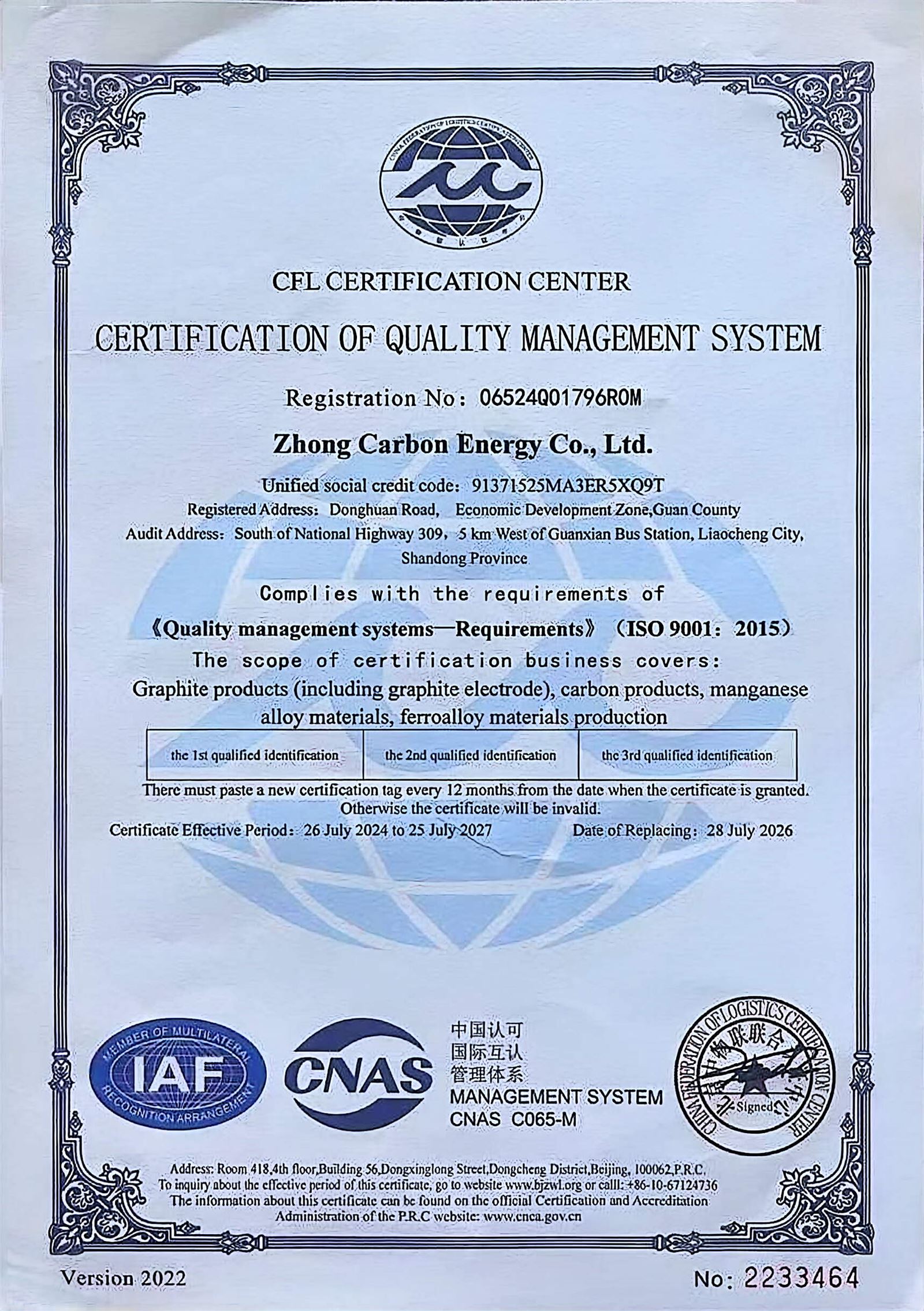
Our Certifications
FAQ
Q: What do you need to know about graphite?
Q: What are the three types of graphite?
Q: What is graphite granular good for?
Q: What are some interesting facts about graphite?
Q: What are some interesting facts about graphite?
Q: What is the purest form of graphite?
Q: How to use graphite granular for beginners?
Q: What is the best binder for graphite granular?
Q: What do I need to know about graphite?
Q: What are the negative effects of graphite?
Q: What is graphite granular used for?
Q: Is there anything stronger than graphite?
Q: What does pure graphite look like?
Q: What do the numbers on graphite mean?
Q: What is the shelf life of graphite granular?
Q: Can you mix graphite powder with water?
As one of the most professional graphite granular manufacturers and suppliers in China, we're featured by quality products and good price. Please rest assured to buy graphite granular for sale here from our factory.