

Metallurgical Coke
Metallurgical coal, also known as met and coking coal, is a naturally occurring sedimentary rock found within the earth’s crust. Met coal encompasses a wide range of quality grades including hard coking coal, semi-hard coking-coal, semi-soft coking coal and pulverised coal for injection (PCI). All are used to make steel. Met coal typically contains more carbon, less ash and less moisture than thermal coal, which is used for electricity generation.
Why Choose Us?
Strict Quality Control
Qitian Products ensure 100% of all graphite petroleum coke meet industry quality standards and passed final inspection and then are carefully packaged for delivery.
Stable Supply Capacity
We have our own production plant, with a daily shipment of up to 100 tons. We have advanced technicians to help us improve production technology and production efficiency.
Professional Management System
The company's system is very complete. From the early stage of customer docking to the later stage of product sales, we can use professional software management to improve efficiency.
24 Hours Service
We can provide the best export service and after-sales service. 24 hours on line for help.


Advantages of Metallurgical Coke
High Carbon Content
Metallurgical coke has a very high fixed carbon content, typically around 85-90%, which makes it an excellent source of carbon for reduction and energy generation in metallurgical processes.
High Calorific Value
The high carbon content of metallurgical coke translates to a high calorific value, providing a significant amount of thermal energy during combustion or reduction reactions.
Structural Integrity
Metallurgical coke is processed to have high mechanical strength, which allows it to withstand the physical stresses encountered in blast furnaces, cupola furnaces, and other high-temperature metallurgical operations.
Porosity and Permeability
The porous structure of metallurgical coke, combined with its high mechanical strength, allows for efficient gas flow and the free passage of reactant gases in metallurgical processes.
Chemical Inertness
Metallurgical coke is relatively inert, with low levels of impurities, making it suitable for use in various high-temperature metallurgical environments without causing significant chemical reactions or contamination.
Consistent Quality
Metallurgical coke production is a well-established and controlled process, ensuring a consistent quality and reliable performance in metallurgical applications.
Environmental Benefits
Compared to alternative fuels, the use of metallurgical coke can result in lower greenhouse gas emissions and better environmental performance in the steelmaking and other metallurgical industries.
Cost-Effectiveness
Metallurgical coke is a relatively cost-effective source of carbon and energy for metallurgical processes, especially when compared to other carbon-rich materials.

Metallurgical coke can be classified into various types based on different production processes and compositions. Some of the types include coke produced through a metallurgical reduction coupling process using slack coal and granular coal, coke under high pyrogenation status containing coke powder, modified asphalt, and coal powder, laminar coke produced in batch-type furnaces using petroleum coking material with specific characteristics, and metallurgical coke compositions prepared from different coal types with varying ratios of fat coals, gaseous-fat coals, lean coke coals, and low-agglomerating coke coals. Additionally, metallurgical cokes are known for their composition of graphitic carbon and inorganic compounds, which exhibit different responses to microwave radiation, leading to improved grindability through microwave-assisted grinding processes. These various types of metallurgical coke serve different industrial purposes and are tailored to specific production requirements.
Application of Metallurgical Coke
Steel Industry
Met coke plays an indispensable role in the steel industry, where it is used in the blast furnace process to produce iron and steel. During this process, Met coke serves as both a reducing agent and a source of energy. As it reacts with iron ore, it reduces the iron oxides, liberating molten iron and producing carbon dioxide gas. This reduction process is vital to obtain crude iron, which later undergoes further refining to produce steel. The quality and properties of Met coke significantly influence the efficiency, productivity, and overall cost of steel production.
Beyond Steel - Non-Ferrous Metals and Smelting Processes
Met coke finds applications beyond the steel sector in the production of non-ferrous metals like aluminum, titanium, and silicon. In smelting processes, such as aluminum smelting, Met coke serves as a reducing agent to convert metal oxides into their elemental forms. This ensures the extraction of pure metals from their ores, facilitating the manufacturing of various non-ferrous metal products. Its exceptional reducing capabilities and stability in high-temperature environments make Met coke a preferred choice in these critical processes.
Foundry Industry and Casting Processes
In the foundry industry, Met coke is extensively used in casting processes. Its uniform heat distribution ensures consistent melting of metals, promoting the production of high-quality castings. Moreover, Met coke's ability to reduce impurities in the molten metal enhances casting precision and reduces the likelihood of defects. Foundries rely on Met coke for its reliability and the excellent surface finish it imparts to the final products.
Chemical Industry
A Versatile Reducing Agent: Met coke plays a crucial role in the chemical industry as a potent reducing agent. It finds application in various chemical reactions, especially in the synthesis of chemicals like calcium carbide and calcium cyanamide. Its capacity to donate electrons during chemical transformations is pivotal in these reactions, leading to the production of essential organic compounds.
Properties and Structure of Metallurgical Coke
Metallurgical coke is a porous, fissured, silver-black solid and is an important part of the ironmaking process since it provides the carbon (C) and heat required to chemically reduce iron burden in the blast furnace (BF) to produce hot metal (HM). It is a porous C material with high strength produced by carbonization of coals of specific rank or of coal blends at temperatures around 1100 deg C in coke ovens. It is composed of both the organic and inorganic matter. C is the major component of the organic part. Small amounts of sulphur (S), nitrogen (N2), hydrogen (H2) and oxygen (O2) also occur in the organic part. The inorganic matter in coke is called coke ash (mineral matter) and is typically around 12 % on dry basis. Both the organic and inorganic components influence coke reactivity. Thus, coke characterization is an important aspect to understand the quality of coke formed.
The basic understanding of coke quality is an important task as it determines the high temperature and gasification behaviours of coke in the blast furnace (BF). As the coke moves towards the lower zones of BF, it degrades and generates fines, which affects the bed permeability and the process efficiency. Hence, superior coke quality is critical for a stable and efficient BF operation.
Coke quality is influenced by many factors such as the rank, the maceral composition (leading to isotropic or anisotropic coke structures), the ash composition and the fluidity of the starting coals, the carbonization conditions including peak temperature, heating rate, particle size, pressure and bulk density as well as heat treatment conditions.
The important properties of coke, including mechanical strength and reactivity, are governed by the arrangement of the constituent C atoms. The principal features of the atomic arrangement are the alignment and size of C crystallites. The size of textural components is regarded as indicative of their chemical reactivity.
Microscopically coke consists of a solid matrix, organic and inorganic inclusions in the matrix, pores and rnicro-fissures. The processes of the development of the porous structure and the micro-texture of coke take place essentially within the plastic range. The structure formed in the coke by the gas bubbles occupies almost half its volume and influences two properties of coke, the mechanical strength and the bulk density. The solid material forming the pore walls consists of optically-anisotropic entities which are usually observed using polarized light microscopy (PLM). The coke micro-texture influences the coke properties which are essential for its use in the BF.
A good quality coke is generally made from carbonization of good quality coking coals. Coking coals are defined as those coals that on carbonization pass through softening, swelling, and re-solidification to coke. One important consideration in selecting a coal blend is that it should not exert a high coke oven wall pressure and should contract sufficiently to allow the coke to be pushed from the oven. The properties of coke and coke oven pushing performance are influenced by following coal quality and battery operating variables: rank of coal, petrographic, chemical and rheologic characteristics of coal, particle size, moisture content, bulk density, weathering of coal, coking temperature and coking rate, soaking time, quenching practice, and coke handling. Coke quality variability is low if all these factors are controlled.
Metallurgical coke is produced by heating coking coal to high temperature in the reducing atmosphere of the by-product coke oven. The coal-to-coke transformation is shown in Fig 2. The coal mix is heated from the oven walls on each side of the coke oven and two plastic layers are developed on each side and converge eventually at the centre of the charge. First, coal near the wall loses water and becomes plastic at 350 deg C to 400 deg C while leaving organic tars. The plastic layers solidify into a semi-coke residue at 450 deg C to 500 deg C while giving off methane and other volatile gases. It takes around 12 hours to 15 hours for the centre of the coke oven to solidify. The semi-coke shrinks and fissures at elevated temperatures of 500 deg C to 1000 deg C losing methane and hydrogen. The coke is pushed out of the coke oven at around 1000 deg C to 1100 deg C, when the volatile matter is less than 1 %. The coke-making process takes around 18 hours to 22 hours, but can vary depending on heating rate and width of the oven.

Main Factors Influencing Metallurgical Coke Texture and Reactivity
Pore structure development
The pore structure of coke is largely determined within the plastic temperature range of the carbonization process. During carbonization, initially pores appear in large particles at a temperature near the softening point, while the medium size particles become porous at higher temperatures. No pore formation is normally detected at any temperature within particles < 125 microns in size. An increase in temperature induces an increase both in the number and the size of pores, and more particles are observed to have pores with the larger particles becoming multi-pored. With increasing temperature, particles become more rounded and swell into the inter-particulate voids. The pore structure of metallurgical coke can vary greatly over a wide range. Within a given coke and between one coke and another coke, the individual pores can vary both in size and in shape. A classification of pores on the basis of their average width was proposed in 1967 and subsequently adopted by IUPAC in 1972. As per this classification, there are three types of pores namely (i) micro-pores (less than 2 nm), (ii) meso-pores (less than 2 nm to less than 50 nm) and macro-pores (greater than 50 nm). The micro-pore size range has been further subdivided into the very narrow ultra-micro-pores (less than 0.5 nm) and super-micro-pores (greater than 1 nm to less than 2 nm). However, coke structure is dominated by large pores (greater than 2 nm) namely meso-pores and the remainder appears relatively dense and smaller than 0.5 nm to1 nm. Higher micro-pore surface area of coke is frequently related to higher anisotropic C content.
Coke ash
Coke ash is the mineral matter present in the coke. Metallurgical coke typically contains around 8 % to 12 % of mineral phases. The proportion of individual minerals present in coke can vary from coke to coke depending on the mineralogy of the original coals as well as the process conditions employed for carbonization. During carbonization, some minerals decompose and some undergo a number of complex reactions, all of which contribute to the formation of new crystalline minerals as well as amorphous phases. X-ray diffraction analysis is normally used to identify and quantify the mineral phases present in the metallurgical coke. For X-ray diffraction analysis, a sample of the mineral matter from the coke is prepared by ‘low temperature radio-frequency plasma ashing’ (LTA) as this technique results in minimal alteration of the mineral matter. Most of the mineral matter present in the coke has been found to be present as an amorphous phase (greater than 50 % in LTA samples). Partially decomposed clays and other material which become structure-less on heating due to the removal of constitutional water or other volatiles are responsible for the formation of amorphous alumino-silicate material. With the exceptions of some artifacts or hydrated minerals such as bassanite, coquimbite and jarosite, the major mineral matter in crystalline phases identified in the metallurgical coke are quartz, mullite, fluorapatite, and pyrrhotite. Metallic iron (Fe), brookite, anatase, rutile, cristobalite, iron oxides (Fe3O4, Fe2O3 and FeO), akermanite and oldhamite are common minerals present in coke.
The Global Metallurgical Coke Market Is Ignited by Several Key Factors
teel Production
With steel being a foundational material in construction, automotive, and manufacturing industries, the demand for metallurgical coke remains closely tied to steel production, driving market growth.
01
Infrastructure Development
Rapid urbanization and infrastructure development projects worldwide require vast amounts of steel, stimulating demand for metallurgical coke as a primary fuel in blast furnaces and other metal smelting facilities.
02
Technological Advancements
Ongoing advancements in coke oven technology and coke quality optimization techniques enhance the efficiency and productivity of metallurgical coke production, meeting the evolving needs of steelmakers.
03
Global Trade Dynamics
The interconnected nature of the global economy and trade networks influences the metallurgical coke market, with factors such as raw material availability, transportation costs, and trade policies impacting market dynamics.
04
Metallurgical Coke Market Trends and Innovations
Environmentally Sustainable Practices
Adoption of environmentally sustainable coke production practices, such as energy recovery systems and emission reduction technologies, to minimize environmental impact and comply with regulatory standards.
Coke Quality Optimization
Focus on improving metallurgical coke quality through coal blend optimization, coke oven design enhancements, and process control measures to ensure consistent performance and cost-effective steel production.
Alternative Fuels and Technologies
Exploration of alternative fuels and emerging technologies, such as biomass co-gasification and hydrogen injection, to reduce greenhouse gas emissions and enhance energy efficiency in coke production processes.
Supply Chain Optimization
Implementation of advanced supply chain management practices, including inventory optimization, logistics automation, and strategic partnerships, to ensure timely and cost-effective delivery of metallurgical coke to steel producers.
Our Factory
The company now has 2 modern production workshops and 2 large storage workshops, which can meet the needs of large-scale production and fast logistics. The annual production volume has reached 100,000 tons. After years of hard work, we have worked closely with many domestic companies and exported to many countries and regions. In the future, the company will continue to adhere to the business philosophy of "quality-oriented, honesty and trustworthiness", continuously improve product quality and service level, carry out extensive cooperation and exchanges with domestic and foreign companies, and jointly promote the development of the carbon industry.

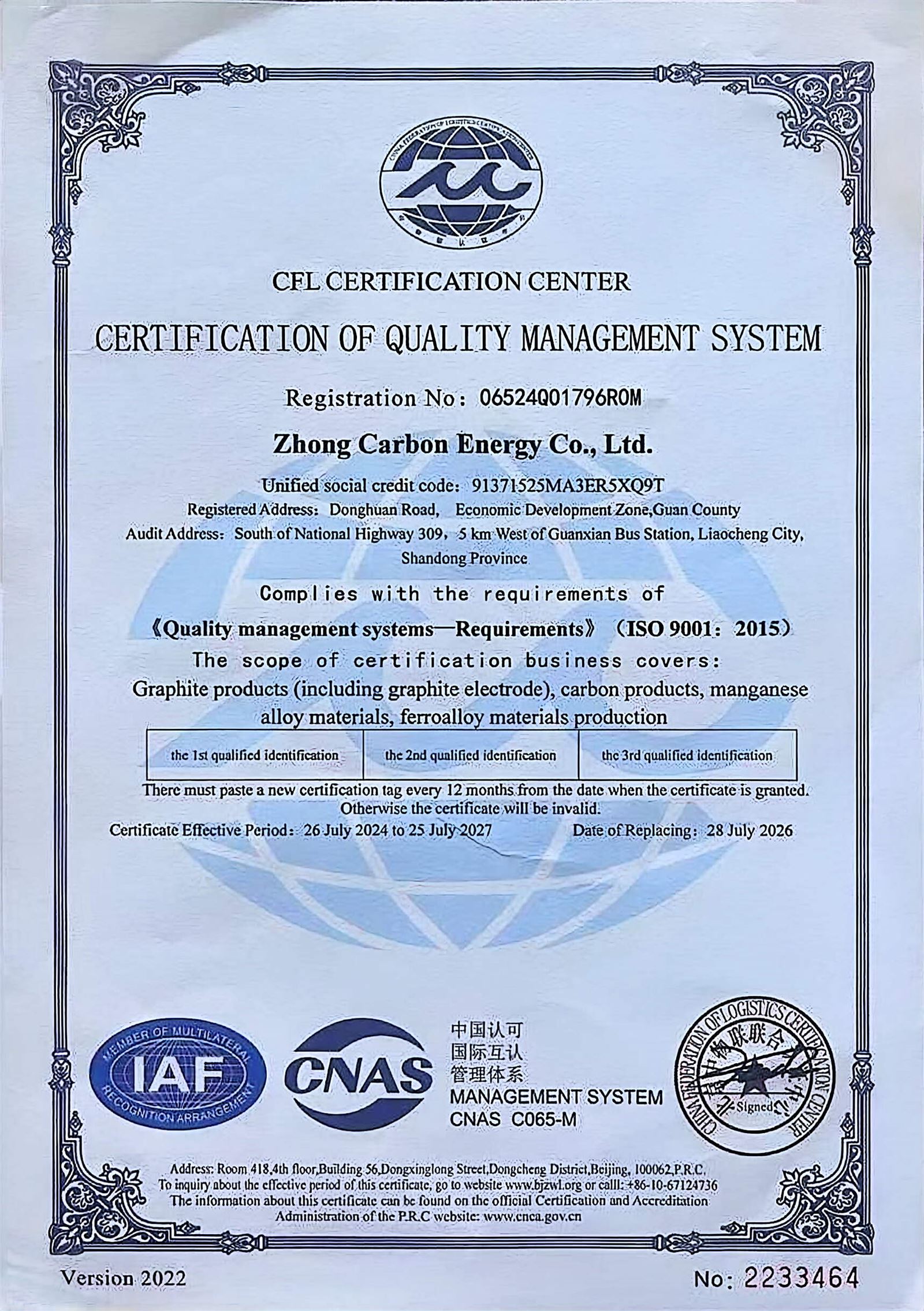
Our Certifications
FAQ
Q: What are the requisites of good metallurgical coke?
Q: What is the importance of metallurgical coke?
Q: What is the process of metallurgical coking?
Q: What are the chemical properties of metallurgical coke?
Ash : 12% max.
VM : 1.5% max.
Sulphur : 0.50 max.
Phosphorus : 0.045 max.
Fixed carbon : 87% min.
CSR : 65 - 68.
CRI : 21 - 24.
Q: Which country produces the most metallurgical coke?
Q: What is the ignition temperature of metallurgical coke?
Q: What is the difference between petcoke and met coke?
Q: How much Sulphur is in metallurgical coke?
Q: What is the importance of coke in metallurgical process?
Q: Is metallurgical coal the same as coking coal?
Q: What is the density of metallurgical coke?
Q: What are the requisites of a good metallurgical coke?
Q: What is the ash content of metallurgical coke?
Q: What type of coal is preferred for the manufacture of metallurgical coke?
Q: What are the characteristics of metallurgical coke?
It has also a low volatile content or rather low waste product content due to the heat treatment process received.
It has a high carbon content, low ash content, and high strength.
Q: What is the analysis of metallurgical coke?
Q: What is the difference between foundry coke and met coke?
Q: What is the composition of metallurgical coke ash?
As one of the most professional metallurgical coke manufacturers and suppliers in China, we're featured by quality products and good price. Please rest assured to buy metallurgical coke for sale here from our factory.
0 30mm Metallurgical Coke, 10 30mm Metallurgical Coke, metallurgical coke