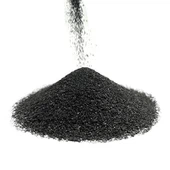
The dissolution rate of carburizing agents in molten iron directly determines their absorption efficiency and final absorption rate.
This is a complex physicochemical process, mainly affected by the following factors:
The following are the main factors affecting the dissolution rate of carburizing agents, listed in order of importance:
I. Temperature (Thermal Factor)
This is the most crucial and significant factor.
• Principle: The dissolution of carburizing agents into molten iron is an endothermic process, requiring the absorption of a large amount of heat.
Higher temperatures mean:
Lower viscosity of molten iron: better fluidity, which is beneficial for the convection and diffusion of carbon atoms.
Increased activity of carbon atoms: greater kinetic energy, making it easier to detach from the surface of the carburizing agent and diffuse into the interior of the molten iron.
Accelerated solid-liquid interface reaction: higher temperatures provide a stronger thermodynamic driving force.
• Influence Pattern: The dissolution rate increases sharply with increasing temperature.
Above 1500℃, the dissolution rate is several times faster than at 1400℃.
II. Material Properties of Carburizing Agents
1. Degree of Graphitization:
• Highly graphitized carburizing agents: Their carbon atoms are arranged in an ordered graphite sheet structure, similar to the graphite structure in cast iron, thus exhibiting better wettability with molten iron.
Molten iron can more easily "wet" into the gaps between the graphite sheets, causing them to peel off layer by layer, resulting in a faster dissolution rate.
• Non-graphitized (e.g., calcined petroleum coke): The carbon structure is disordered and dense, resulting in poor wettability with molten iron. Molten iron has difficulty penetrating, and dissolution mainly relies on slow surface dissolution, leading to a slow rate.
2. Particle Size and Shape:
• Particle Size: There exists an optimal particle size range (typically 1-5 mm).
Too fine particles: Easily float on the liquid surface, resulting in severe burn-off and a short actual contact time with molten iron.
Too large particles: Small total surface area, and easily sink to the bottom, resulting in a small contact area with molten iron and a long dissolution time.
• Porosity: Porous, loose carburizing agents (such as some low-quality carburizing agents) provide more penetration channels for molten iron, resulting in rapid initial dissolution, but may lead to a low net absorption rate due to rapid burn-off.
III.Molten Iron Condition
1. Chemical Composition of Molten Iron:
• Carbon Saturation: The closer the carbon content of the molten iron is to its saturation concentration (determined by carbon equivalent CE), the weaker the "driving force" for dissolving carbon, and the slower the dissolution rate.
• "Blocking" Elements:
Silicon (Si): The main blocking element.
Silicon reduces the solubility of carbon in molten iron and adsorbs onto the surface of the carburizing agent, forming a blocking layer that significantly reduces the dissolution rate. This is the important reason why carbon must be added before silicon.
Manganese (Mn): Has a smaller impact and can even indirectly eliminate the adverse effects of sulfur by reacting with sulfur to form MnS.
• "Promoting" Elements:
Sulfur (S): On the surface, sulfur reacts with carbon or changes surface tension, hindering dissolution.
More importantly, sulfur significantly reduces the wettability of molten iron with recarburizers (especially graphitic carbon), acting as a strong inhibitor of dissolution rate.
2. Flow and Stirring of Molten Iron:
• Principle: Strong convection and stirring can:
Rapidly remove the saturated carbon-rich layer on the surface of the recarburizer, exposing new surfaces for continued dissolution.
Prevent the recarburizer from agglomerating and settling, ensuring its uniform distribution in the molten iron.
• Method: Electromagnetic stirring in a medium-frequency induction furnace is an extremely effective method.
Manual stirring also has some effect.
IV. Operation Process
1. Addition Methods:
• Bottom Addition: The recarburizer is covered by the furnace charge and begins to dissolve slowly from the very first moment the molten iron melts. This method offers the longest effective dissolution time and occurs in a relatively low-temperature region, resulting in minimal burn-off and the highest overall dissolution and absorption efficiency.
• Mid-Cycle Addition: Added when a molten pool already exists, avoiding initial burn-off. Dissolution relies on electromagnetic stirring, resulting in a faster rate.
• Surface Sprinkling: The worst method.
When carburizers are exposed to high temperatures and air, a significant amount burns away, and they float on the surface, failing to effectively contact the molten iron, resulting in an extremely low effective dissolution rate.
By systematically understanding and controlling these factors, the dissolution rate of carburizers can be significantly improved, thereby achieving efficient, stable, and low-cost carburizing effects.