

As a supplier of 0 - 1mm Graphitized Petroleum Coke, I often encounter inquiries regarding the specific surface area of this product. The specific surface area is a crucial property that significantly impacts the performance and applications of Graphitized Petroleum Coke. In this blog, I will delve into the concept of specific surface area, its measurement, and its relevance to 0 - 1mm Graphitized Petroleum Coke.
Understanding Specific Surface Area
Specific surface area refers to the total surface area of a material per unit mass or volume. In the case of Graphitized Petroleum Coke, it represents the cumulative area of all the pores, cracks, and external surfaces of the coke particles. This property is typically expressed in square meters per gram (m²/g). A higher specific surface area indicates a greater surface area available for chemical reactions, adsorption, or other interactions.
The specific surface area of a material is influenced by various factors, including its particle size, shape, porosity, and the degree of graphitization. In general, smaller particles have a larger specific surface area because they expose more surface area per unit mass. Additionally, materials with a high degree of porosity or a complex surface structure tend to have a larger specific surface area.
Measuring the Specific Surface Area of 0 - 1mm Graphitized Petroleum Coke
There are several methods available for measuring the specific surface area of Graphitized Petroleum Coke. One of the most commonly used techniques is the Brunauer - Emmett - Teller (BET) method. This method is based on the physical adsorption of gas molecules onto the surface of the material at low temperatures. By measuring the amount of gas adsorbed at different pressures, the BET equation can be used to calculate the specific surface area of the sample.
Another method is the Langmuir method, which is similar to the BET method but assumes a monolayer adsorption of gas molecules. This method is often used for materials with a relatively simple surface structure and a low degree of porosity.
In addition to these gas adsorption methods, other techniques such as mercury intrusion porosimetry and scanning electron microscopy (SEM) can also provide information about the specific surface area and pore structure of Graphitized Petroleum Coke. Mercury intrusion porosimetry measures the volume of mercury that can penetrate the pores of the material under different pressures, while SEM provides a visual representation of the surface morphology and particle size distribution.

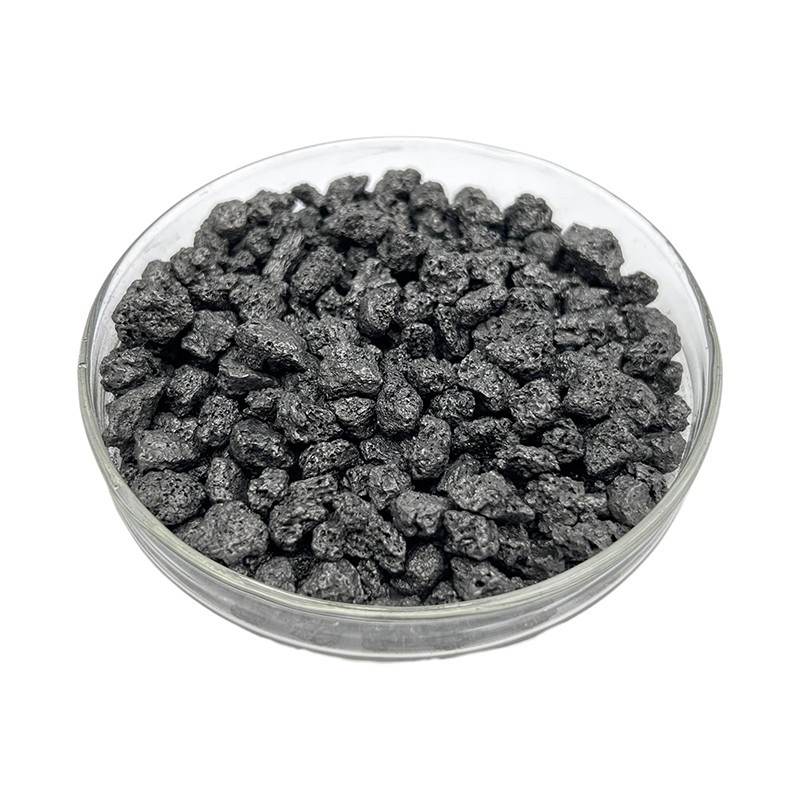
Factors Affecting the Specific Surface Area of 0 - 1mm Graphitized Petroleum Coke
As mentioned earlier, the specific surface area of 0 - 1mm Graphitized Petroleum Coke is influenced by several factors. Here are some of the key factors:
Particle Size
The particle size of Graphitized Petroleum Coke has a significant impact on its specific surface area. Smaller particles have a larger surface area per unit mass, which means that 0 - 1mm Graphitized Petroleum Coke generally has a higher specific surface area compared to larger - sized particles. This is because the surface area of a particle is proportional to the square of its radius, while its volume is proportional to the cube of its radius. Therefore, as the particle size decreases, the surface - to - volume ratio increases.
Porosity
Porosity refers to the volume of pores within the Graphitized Petroleum Coke particles. Materials with a high porosity have a larger specific surface area because the internal pores provide additional surface area for interactions. The porosity of Graphitized Petroleum Coke can be affected by the manufacturing process, the raw materials used, and the degree of graphitization.
Degree of Graphitization
The degree of graphitization is another important factor that affects the specific surface area of Graphitized Petroleum Coke. Graphitization is a process in which the carbon atoms in the petroleum coke are rearranged into a more ordered graphite structure. A higher degree of graphitization generally results in a lower specific surface area because the graphite structure is more compact and has fewer pores and defects.
Importance of Specific Surface Area in Applications
The specific surface area of 0 - 1mm Graphitized Petroleum Coke plays a crucial role in its various applications. Here are some examples:
Metallurgical Industry
In the metallurgical industry, Graphitized Petroleum Coke is commonly used as a carbon additive in the production of steel, cast iron, and other metals. The specific surface area of the coke affects its reactivity and ability to dissolve in the molten metal. A higher specific surface area allows for a faster reaction rate and better dispersion of the carbon in the metal, which can improve the quality and performance of the final product. For more information about Graphitized Petroleum Coke For Metallurgical Industry, you can visit our website.
Cast Steel Production
In cast steel production, Graphitized Petroleum Coke is used to adjust the carbon content and improve the mechanical properties of the steel. The specific surface area of the coke influences its ability to react with the molten steel and form a homogeneous carbon - steel alloy. A larger specific surface area can enhance the carbon absorption rate and reduce the formation of impurities, resulting in a higher - quality cast steel product. Check out our Graphitized Petroleum Coke For Cast Steel page for more details.
Other Applications
Graphitized Petroleum Coke is also used in other applications such as battery electrodes, carbon brushes, and refractory materials. In these applications, the specific surface area affects the performance of the product by influencing factors such as conductivity, adsorption capacity, and mechanical strength.
Controlling the Specific Surface Area of 0 - 1mm Graphitized Petroleum Coke
As a supplier, we understand the importance of controlling the specific surface area of 0 - 1mm Graphitized Petroleum Coke to meet the specific requirements of our customers. We employ advanced manufacturing processes and quality control measures to ensure that our products have a consistent and appropriate specific surface area.
One of the ways we control the specific surface area is by carefully selecting the raw materials and optimizing the graphitization process. By choosing high - quality petroleum coke and adjusting the temperature, time, and other parameters during graphitization, we can achieve the desired degree of graphitization and porosity, which in turn affects the specific surface area.
In addition, we also use particle size classification techniques to ensure that the 0 - 1mm Graphitized Petroleum Coke has a narrow particle size distribution. This helps to maintain a consistent specific surface area and improve the overall quality of the product.
Conclusion
The specific surface area of 0 - 1mm Graphitized Petroleum Coke is a critical property that affects its performance and applications in various industries. By understanding the factors that influence the specific surface area and implementing appropriate control measures, we can provide high - quality products that meet the specific needs of our customers.
If you are interested in purchasing 0 - 1mm Graphitized Petroleum Coke or have any questions about its specific surface area or other properties, please feel free to contact us for further discussion and procurement negotiation. We also offer 4 - 7mm Graphitized Petroleum Coke and other related products.
References
- ASTM D6556 - 17, Standard Test Method for Carbon Black—Total and External Surface Area by Nitrogen Adsorption.
- Gregg, S. J., & Sing, K. S. W. (1982). Adsorption, Surface Area and Porosity. Academic Press.
- Rouquerol, F., Rouquerol, J., & Sing, K. (1999). Adsorption by Powders and Porous Solids: Principles, Methodology and Applications. Academic Press.