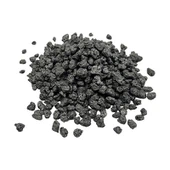
In the production of ductile iron, graphitized petroleum coke (GPC) is mainly used as a carburizer and graphite nucleation core. Its characteristics affect the performance and life of the material in the following ways:
The high carbon content of graphitized petroleum coke, for example, the carbon content needs to be ≥98%, which can effectively supplement the carbon element in the molten iron, reduce the shrinkage or hard spots caused by insufficient carbon, and ensure the uniform structure of the casting. Lower impurities, such as ash content ≤0.5%, reduce harmful elements such as sulfur and phosphorus, and avoid the formation of brittle phases (such as FeS), thereby reducing the tendency to crack and extending fatigue life.
The graphitized carbon layer structure of GPC can be used as a nucleation substrate to promote the uniform precipitation of spheroidal graphite. Experiments show that the spheroidization rate of ductile iron using GPC is increased by about 15%-20% (ASTM A247 standard rating). Low sulfur ≤0.3%, the characteristics reduce the consumption of spheroidizers such as magnesium, ensure the stability of graphite spheroidization effect, and avoid stress concentration caused by flake graphite. The microporous structure of GPC, with a specific surface area of ≤5 m²/g, increases its dissolution rate in molten iron by 30%, reducing the composition fluctuation caused by carbon increase lag. Low volatile matter ≤1.5%, avoids gas precipitation during casting, reduces porosity (can be controlled at ≤0.5%) and improves the density of castings.
Ductile iron carburized by GPC, such as QT600-3, can increase its tensile strength to 650-700 MPa, compared with 600 MPa in traditional processes. The uniform distribution of spheroidal graphite stabilizes the elongation at 12%-15%, which is better than the 10%-12% of ordinary carburizers. Low impurity content reduces the micro-battery effect, and the salt spray test (ASTM B117) shows that the corrosion rate is reduced by about 20%. Corrosion resistance is significantly improved. In actual applications, after the automotive parts factory switched to GPC, the fatigue life of the crankcase casting increased from 500,000 cycles to 700,000 cycles, according to the SAE J1099 standard. Municipal pipelines use GPC carburized ductile iron. After 20 years of service, the inner wall corrosion depth is only 1/3 of the traditional process.
Therefore, when producing ductile iron, graphitized petroleum coke with fixed carbon ≥98.5%, sulfur ≤0.2%, and nitrogen ≤0.03% can be used. The particle size distribution is 0.5-3mm, and different sizes of particles are adapted according to different induction furnaces. When in use, first preheat it at a temperature of 200-300℃ to remove adsorbed moisture, and then add it in batches, and cooperate with electromagnetic stirring to ensure uniform dissolution. Although the unit price of GPC is high, the qualified rate of castings is increased by 5%-8%, the comprehensive cost is reduced by 2%-3%, and the comprehensive cost-effectiveness is improved.
By optimizing the selection of carburizes, graphitized petroleum coke can significantly improve the comprehensive performance and service life of ductile iron, especially in the industrial field with high precision and high-reliability requirements. It has strategic value.