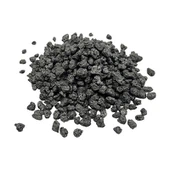
With the rapid development of new energy vehicles and the energy storage industry, the demand for lithium-ion batteries continues to grow, which in turn drives the market demand for graphitized petroleum coke as anode materials. It is expected that by 2025, the global demand for anode materials for lithium-ion batteries will reach 3 million tons, and the demand for petroleum coke and needle coke will exceed 4 million tons. This indicates that the application of graphitized petroleum coke in energy storage batteries is very promising.
Performance Advantages
Graphitized petroleum coke has a low thermal expansion coefficient, low pore content, low sulfur content, low ash content, low metal content, and high electrical conductivity, which makes it ideal for anode materials in lithium-ion batteries. For example, low-sulfur petroleum coke with graphitization treatment can achieve a first coulombic efficiency of 82.79% and a stable capacity of 273.1 mAh/g after 200 cycles, with a capacity retention rate of 99.4%, showing excellent cycle stability and multiplier performance.
Cost Effectiveness
Graphitized petroleum coke is a widely available and low-cost raw material. After graphitization, its performance significantly improves to meet the requirements of high-performance lithium-ion batteries. In addition, the production process of graphitized petroleum coke has been optimized to further reduce production costs, making it more economical for large-scale energy storage applications.
Technology optimization and modification
It has been found that the microstructure of petroleum coke can be optimized by controlling the graphitization temperature and process, thus enhancing its electrochemical performance. For example, the specific capacity of petroleum coke treated with graphitization at 2600°C can reach 326.1mAh/g for the first discharge, and the capacity almost does not decay after 100 cycles. In addition, its cycling performance and low-temperature performance can be further improved by modification means such as nano-coating and conductive carbon layer coating.
Future Development Direction
The application of graphitized petroleum coke in energy storage batteries is not limited to lithium-ion batteries, but may also be extended to new energy storage systems such as sodium-ion batteries. In addition, with the continuous progress of technology, graphitized petroleum coke is expected to play a greater role in high-performance, long-life energy storage batteries.
With its excellent electrochemical performance, cost-effectiveness, and wide market potential, graphitized petroleum coke has a promising application in energy storage batteries. In the future, with the further optimization of technology and the continuous growth of market demand, graphitized petroleum coke is expected to occupy a more important position in the field of energy storage.