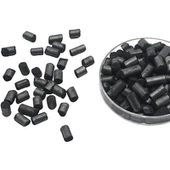
Graphitized petroleum coke recarburizer is an additive widely used in the steel smelting and casting industries. Its main function is to increase the carbon content in molten iron or steel, thereby improving the performance of the material. According to different classification standards, graphitized petroleum coke recarburizer can be divided into many types:
1. Classification by degree of graphitization:
1.1 Graphitized recarburizer: After high-temperature graphitization treatment, it has high purity, good particle morphology and graphitized hexagonal crystal structure, which can improve the mechanical properties and processing properties of cast iron.
1.2 Semi-graphitized recarburizer: It has both the high absorption rate of graphitized recarburizer and the low cost of calcined coke recarburizer, and has a high cost performance.
2. Classification by shape and performance:
2.1 Sponge coke: high chemical reactivity, low impurity content, mainly used in aluminum smelting industry and carbon industry.
2.2 Pellets or spherical coke: spherical in shape, generally produced from high-sulfur, high-asphalt residue oil, can only be used as industrial fuel for power generation, cement, etc.
2.3 Fluidized coke: produced by fluidized coking process, with fine particles, high volatile matter, high thermal expansion coefficient, and cannot be directly used in electrode preparation and carbon industry.
2.4 Needle coke: has a series of advantages such as low thermal expansion coefficient, low porosity, low sulfur, low ash content, low metal content, high conductivity and easy graphitization, mainly used for the preparation of ultra-high power graphite electrodes and artificial graphite negative electrode materials.
3. Classification by casting use:
3.1 Ductile iron recarburizer: Mainly used for ductile iron, with high carbon content and low sulfur content, high absorption rate. Carbon content is greater than 98.5%, sulfur content is less than 0.05%, mainly used for graphitized petroleum coke and graphitized electrodes.
3.2 Gray iron recarburizer: Mainly used for gray cast iron, with relatively low carbon content and high sulfur content. Carbon content is greater than 90%, sulfur content is less than 0.5%, mainly non-graphitized petroleum coke and calcined coal
3.3 Steelmaking recarburizer: Used in the steelmaking process, the carbon content is between ductile iron recarburizer and gray iron recarburizer. Carbon content is between 75-98%, mainly calcined coal, graphite balls and natural graphite crushed
3.4 Special recarburizer: Used for special applications such as brake pads and cored wire, usually with specific particle size requirements. Used for brake pads and cored wire, generally 0-0.5/0.5-1 mm petroleum coke.
4. Classification by material:
4.1 Metallurgical coke recarburizer: usually used in cupolas, in addition to smelting, it is also used for metal furnace charge recarburization.
4.2 Calcined coal recarburizer: the main component is 90-93% carbon and 0.3-0.5% sulfur, mainly used in steelmaking enterprises.
4.3 Petroleum coke recarburizer: made by calcining and purifying petroleum coke, with round or multi-faceted appearance, characterized by high carbon, low sulfur and low ash, suitable for metallurgical chemical industry, machinery, power and other industries.
4.4 Graphitized recarburizer: the main material is graphitized petroleum coke and graphitized electrode, with carbon content greater than 98-99.5% and sulfur content less than 0.05-0.03%, mainly used for ductile iron.
4.5 Natural graphite recarburizer: mainly natural graphite, with carbon content ranging from 65-99%, mainly used in steelmaking plants.
4.6 Composite material recarburizer: artificially made from graphite powder, coke powder and petroleum coke, with a carbon content between 93-97% and a sulfur content between 0.09-0.7%.
These classifications reflect the diversification and specialization of graphitized petroleum coke recarburizers in different industrial applications.