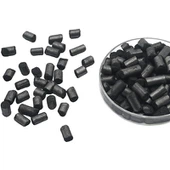
Cast iron is an iron-carbon alloy with a carbon content greater than 2.11% (generally 2.5-4%). It is a multi-element alloy with iron, carbon and silicon as the main components and contains more impurities such as manganese, sulfur and phosphorus than carbon steel. Sometimes, in order to improve the mechanical properties or physical and chemical properties of cast iron, a certain amount of alloying elements can be added to obtain alloy cast iron.
According to the different forms of graphite in cast iron, cast iron can be divided into the following types:
1. Gray cast iron
The graphite in cast iron exists in flakes.
2. Malleable cast iron
The graphite in cast iron exists in floccules. It is obtained by annealing a certain amount of white cast iron at high temperature for a long time. Its mechanical properties (especially toughness and plasticity) are higher than those of gray cast iron, so it is usually called malleable cast iron.
3. Ductile cast iron
The graphite in cast iron exists in spherical form. It is obtained after spheroidization treatment before pouring molten iron. This type of cast iron not only has higher mechanical properties than gray cast iron and malleable cast iron, but also has a simpler production process than malleable cast iron, and its mechanical properties can be further improved through heat treatment, so its application in production is becoming more and more extensive.
The influence of graphite petroleum coke on different types of cast iron can be analyzed from the following aspects:
1. Influence on gray cast iron:
Graphite in gray cast iron is in the form of flakes. The strength, plasticity and toughness of flake graphite are almost zero. The presence of graphite is equivalent to the presence of holes and microcracks. It not only destroys the continuity of the matrix and reduces the effective force area of the matrix, but also forms stress concentration at the tip of the graphite flake, causing the material to form brittle fracture. Therefore, the tensile strength and plasticity of gray cast iron are low, but the compressive strength, hardness and wear resistance mainly depend on the matrix. The presence of graphite has little effect on them. The compressive strength of gray cast iron is generally 3-4 times the tensile strength.
2. Influence on ductile iron:
Graphite in ductile iron is spherical, which has little cutting effect on the metal matrix, making the matrix more continuous, and the phenomenon of stress concentration caused by stretching is significantly reduced, thereby increasing the matrix strength utilization rate from 30%~50% of gray cast iron to 70%~90%. This makes the tensile strength, plasticity, toughness and fatigue strength of ductile iron not only higher than other cast irons, but also comparable to cast steel with corresponding structures.
3. Impact on vermicular cast iron:
The graphite in vermicular cast iron is worm-shaped. This form of graphite has less cutting effect on the metal matrix than flake graphite, but greater than spheroidal graphite. The mechanical properties of vermicular cast iron are between gray cast iron and ductile cast iron. It has good strength and toughness, while maintaining the good casting performance and vibration absorption performance of gray cast iron.
4. Chemical composition control:
Graphite petroleum coke is used as a carburizer, and its nitrogen content has a significant effect on the performance of cast iron. For every 10ppm increase in nitrogen content, the strength of gray cast iron can be increased by 5 to 7MPa, and the hardness can be increased by 3 to 4HBW. The right amount of nitrogen can shorten the length of graphite flakes, increase the degree of bending, passivate the ends, reduce the aspect ratio, stabilize the pearlite of the matrix, refine the grain structure, and improve the tensile strength and hardness of the casting. However, when the nitrogen content of cast iron exceeds the critical point (generally considered to be about 140ppm), nitrogen pores will be generated in the casting.
5. Impact on graphite morphology:
The use of graphite petroleum coke can affect the morphology of graphite in cast iron, and thus affect the performance of cast iron. For example, an appropriate amount of nitrogen can promote the spheroidization of graphite, reduce the creep rate, and increase the tendency of castings to form shrinkage cavities and shrinkage.
In summary, the impact of graphite petroleum coke on different types of cast iron is mainly reflected in the change of graphite morphology, the control of chemical composition, and the final mechanical properties of cast iron. Different types of cast iron have different sensitivities to the element content in graphite petroleum coke, so in actual production, it is necessary to select appropriate graphite petroleum coke according to the specific type of cast iron and performance requirements.