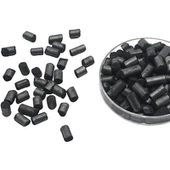
The relationship between ductile iron, gray cast iron, and graphitized petroleum coke is mainly reflected in the application of carburizers in the casting process and their effects on material properties. The following is a detailed analysis of their relationship:
1. Basic characteristics of ductile iron and gray cast iron
Ductile iron: Graphite is spherical, has high strength, high toughness, and good impact resistance, and is widely used in mechanical parts.
Gray cast iron: Graphite is flake-shaped and has excellent casting performance, shock absorption, and wear resistance. However, it is brittle and is often used in shell parts.
2. The key role of graphitized petroleum coke in cast iron production
The first is the carburizing effect, which supplements carbon elements during the smelting process, adjusts the carbon content of molten iron, and ensures that the cast iron reaches the target composition. Generally, high carbon content (≥98%) and low impurities (sulfur, nitrogen, etc.) reduce the negative impact on cast iron performance. The second is to promote the graphitization of cast iron, as a nucleation substrate, to promote graphite precipitation. Its ordered structure helps to evenly distribute graphite and improve mechanical properties. Then there is the purity advantage. The low sulfur (<0.5%) characteristic is particularly important for ductile iron to avoid sulfur interfering with the effect of spheroidizers (such as magnesium) and ensure the spheroidization effect of graphite. Gray cast iron has a high tolerance for sulfur, but low-sulfur recarburizers can still reduce defects such as pores.
3. Differences in the application of graphitized petroleum coke in two types of cast iron
In ductile iron, strict requirements for recarburizers are required, and extremely low sulfur content is required to prevent spheroidization failure. The high purity of graphitized petroleum coke ensures the formation of spheroidal graphite and material properties. The graphite morphology is mainly controlled by the addition of magnesium/rare earth to control the spheronization process, while the recarburizer mainly optimizes the carbon content and purity. In gray cast iron, the recarburizer purity requirement is relatively low, but the sulfur content still needs to be controlled to avoid excessive brittleness. Graphitized petroleum coke can improve the quality of gray cast iron, but the cost may be high. The formation of flake graphite is more affected by cooling rate and composition (such as silicon), and the role of recarburizer is mainly to adjust carbon.
In summary, graphitized petroleum coke, as a high-efficiency recarburizer, is the core link, providing high-quality carbon sources for both types of cast iron. Its low impurity characteristics are particularly in line with the high standards of ductile iron. Graphitized petroleum coke plays a key role in improving the quality of cast iron, especially in the field of high-end ductile iron, where its importance is even more prominent. During use, by optimizing the carbon content and purity of graphite petroleum coke, the uniform precipitation of graphite is indirectly promoted, thereby improving the strength, toughness, or processing performance of cast iron. Therefore, in the production of ductile iron, the raw materials used will rely more on high-purity graphitized petroleum coke to ensure the spheroidization effect; gray cast iron may choose the type of recarburizer based on the cost-effectiveness of the factory.