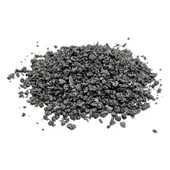
Graphitized petroleum coke (GPC) is not simply "baked carbon." It is petroleum coke transformed by extreme heat into a crystalline material with radically different properties. Here is what actually happens, in brief.
Raw Material Limits
Graphitization starts with low‑sulfur petroleum coke (≤0.5% S). Higher sulfur causes cracking during heat treatment. Ash should stay below 0.3% – every 0.1% ash costs you 10‑15% in resistivity.
Step 1: Calcination (1200–1400°C)
Coke is heated for 8‑12 hours to drive off volatiles and moisture. Fixed carbon rises to ≥98.5%, true density reaches ≥2.05 g/cm³. This is preparation, not graphitization --- the carbon structure remains disordered.
Step 2: Graphitization (2800–3000°C)
The calcined coke is loaded into an Acheson furnace and heated by electrical resistance. Peak temperature is held for 48–72 hours.
At 3000°C, carbon atoms rearrange into an ordered hexagonal graphite lattice. Resistivity plunges from ~500 μΩ·m (calcined coke) to ≤20 μΩ·m. True density climbs to 2.18–2.26 g/cm³.
Temperature must be uniform across the furnace (±150°C core‑to‑edge), and heating must be slow – rushing causes thermal cracks.
Step 3: Slow Cooling
After 2‑3 days at peak temperature, cooling takes another 8‑10 days at ≤20°C/h. Rapid cooling traps internal stress – the product may crack later in transit or use.
Step 4: Crushing, Screening & Optional Purification
Cooled graphite is crushed and classified into target sizes (0.2–10 mm typical for carburizers). For ultra‑high purity, halogen or vacuum purification further reduces ash to ≤50 ppm.
Property Transformation – In One Table
|
Property |
Before (Calcined Coke) |
After (GPC) |
|
Resistivity |
~500 μΩ·m |
≤20 μΩ·m |
|
True density |
~2.05 g/cm³ |
2.18–2.26 g/cm³ |
|
Sulfur |
As raw |
≤0.05% |
|
Ash |
≤0.5% |
≤0.5% (or less) |
|
Carbon recovery (as carburizer) |
70-80% |
90-95% |
The Takeaway
Graphitization changes carbon from a poor conductor into a near‑metallic conductor with outstanding thermal stability and purity. The process is expensive and time‑consuming – a full cycle takes 12‑17 days. That is why GPC costs more than calcined coke, and why its performance in high‑end steel, ductile iron, and battery applications is unmatched.
When you buy GPC, you are paying for the heat, the time, and the control.