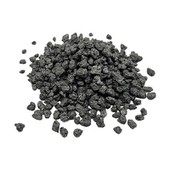
In industrial production, the selection of high-carbon and low-sulfur graphitized petroleum coke is mainly based on the following reasons:

1. Advantages of high carbon
Improved conductivity: High carbon content (usually ≥98%) makes the material have excellent conductivity, which is crucial for applications such as pre-baked anodes for aluminum electrolysis and lithium battery negative electrode materials.
Structural stability: High carbon means fewer impurities, and cracking or deformation at high temperatures is not easy. For example, in electric arc furnace steelmaking, graphite electrodes must withstand extreme conditions above 3000℃.
Reduced energy consumption: For every 1% increase in carbon content, the current efficiency of electrolytic aluminum production can be increased by about 0.5%, directly reducing the power consumption per ton of aluminum by about 150 kWh.
2. The necessity of low sulfur
Environmental compliance: Sulfur content ≤0.5% can meet the requirements of EU REACH and other regulations to avoid excessive SO₂ emissions.
Equipment protection: H₂S gas generated by sulfur at high temperatures will accelerate equipment corrosion. Reducing the sulfur content by 0.1% can extend the life of the metallurgical furnace by about 200 times.
Product quality: In the field of lithium batteries, sulfur impurities will cause the self-discharge rate of the battery to increase. A sulfur content of ≤0.3% can increase the battery cycle life to more than 2,000 times.
Industry application examples
Aluminum electrolysis industry: According to the YS/T 625-2018 standard, high-quality prebaked anodes require fixed carbon ≥98.5% and sulfur ≤0.8%
Steel industry: UHP (ultra-high power) graphite electrodes require a sulfur content of ≤0.3% (based on GB/T 3073-2016)
New energy field: negative electrode materials for power batteries generally require a sulfur content of ≤0.2% (refer to T/CIAPS 0006-2018)
Therefore, when purchasing, it is necessary to combine specific process parameters: for example, electrolytic cells used for continuous production should choose petroleum coke with a stricter sulfur content (≤0.3%), while intermittent production equipment can be appropriately relaxed to 0.5%. At the same time, it is recommended to require suppliers to provide third-party test reports (such as ICP-OES sulfur content test data issued by SGS).