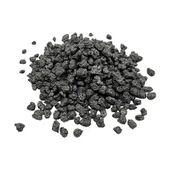
When sourcing low-sulfur, low-nitrogen GPC, one should not look solely at fixed carbon content. This article provides a detailed breakdown of how three key indicators-sulfur, nitrogen, and ash-can lead to specific defects in ductile iron, cast steel, and precision castings. It aims to help procurement professionals in the metallurgical sector better understand these specifications, ensure consistent casting quality, and reduce scrap rates.
For manufacturers of ductile iron, alloy steel, and precision steel castings, the selection of graphitized petroleum coke (GPC) as a recarburizer hinges not only on carbon absorption efficiency but also on the levels of three critical impurities: sulfur, nitrogen, and ash. Many procurement agents focus exclusively on fixed carbon, neglecting impurity control. This often results in large-scale production issues-such as porosity, pinholes, inclusions, hot shortness, and the degradation of the nodularization process-leading to significant costs from rework and scrapped parts.
As a manufacturer and supplier of GPC with extensive experience serving the foundry and steelmaking industries both domestically and internationally, we will break down the impact of sulfur, nitrogen, and ash on castings and provide guidance on selecting the appropriate specifications for different types of cast products.
- The Impact of Sulfur Content on Castings
In molten iron and steel, sulfur is considered a harmful element. It readily reacts with alloying elements like iron and magnesium to form sulfide inclusions.
1. Ductile Iron: Sulfur preferentially consumes the magnesium present in the nodularizing agent, leading to the degradation of the nodularization process, deformation of graphite nodules, and poor nodularization. If sulfur levels exceed limits, even increasing the amount of nodularizing agent will not prevent the deterioration of graphite morphology; this results in a significant decline in the mechanical strength and elongation of the casting. Furthermore, it facilitates the formation of sulfide inclusions, which can manifest as internal slag-filled pores.
2. Cast Steel / Alloy Steel: High sulfur content is a common cause of hot shortness (hot cracking). During the high-temperature solidification phase, low-melting-point sulfides accumulate at the grain boundaries. As the casting cools, the resulting thermal stress causes cracks to form-a risk that is particularly high for thin-walled or geometrically complex castings. 3. Additional Notes:
Conventional Calcined Petroleum Coke (CPC) typically has a high sulfur content, which is difficult to keep stable. In contrast, low-sulfur Graphitized Petroleum Coke (GPC)-produced via high-temperature graphitization-allows for sulfur levels to be consistently maintained below 0.05%; for high-end ductile iron, the requirement can be as strict as S ≤ 0.03%.
However, lower sulfur is not always better. Some gray iron casting processes rely on a small amount of sulfur to facilitate graphite precipitation. Therefore, sulfur specifications must be aligned with the specific casting process; blindly pursuing ultra-low sulfur levels only serves to unnecessarily increase raw material costs.
- The Impact of Nitrogen Content on Castings (The Most Troublesome Parameter in Foundry Operations)
Nitrogen is a parameter that frequently causes issues for foundries and serves as a key differentiator between high-quality GPC and semi-graphitized coke. The solubility of nitrogen in molten iron varies significantly with temperature; as the metal solidifies, solubility drops sharply, causing free nitrogen to precipitate and form nitrogen-induced porosity.
1. Pinholes and Subsurface Porosity: These are the most common defects resulting from excessive nitrogen. The pores are typically small and dispersed, often located just beneath the casting's surface-remaining hidden until revealed during grinding. As such, they are considered "latent" defects; they frequently lead to failure during non-destructive testing (NDT) of castings intended for export, resulting in immediate rejection. Ductile iron is particularly sensitive to nitrogen, with a typical requirement of ≤ 300 ppm.
2. Aging Embrittlement: Nitrogen can react with iron to form nitride phases. Over time, this causes the casting to lose toughness and become brittle, leading to a failure to meet impact strength requirements-a significant concern for components used in construction machinery and automotive parts.
3. Common Misconceptions:
Even when labeled as "graphitized petroleum coke," semi-graphitized products often struggle to achieve low nitrogen levels. Many low-cost GPC offerings fail specifically due to high nitrogen content; while they may exhibit the characteristic graphitic luster, they consistently cause porosity defects during the melting process.
While gray iron and certain types of cast steel may have a higher tolerance for nitrogen-allowing for slightly more relaxed specifications-high-end castings for export, as well as high-grade ductile iron (such as QT450, QT500, and QT600), strictly require the use of low-nitrogen GPC.
- Impact of Ash Content on Castings
Ash consists of inorganic mineral impurities that remain after the combustion of GPC (Graphitized Petroleum Coke). Its primary components include silicon dioxide, aluminum oxide, iron oxide, and calcium and magnesium oxides.
1. Slag Inclusion Defects: When ash enters molten iron, it forms solid oxide inclusions. Because their specific gravity is close to that of molten iron, they do not easily float to the surface to join the slag layer. Instead, they remain trapped within the casting, creating slag holes or inclusions. This compromises the density of the casting-leading to potential leakage in pressure-bearing components-and results in failure during non-destructive testing (NDT).
2. Alteration of Slag Properties: High ash content increases the viscosity of the slag, making it difficult to remove. As the volume of slag within the furnace accumulates, it complicates deoxidation and slag-removal processes. Furthermore, it accelerates the erosion of the furnace lining, thereby shortening the service life of the induction furnace lining.
3. Indirect Effect on Chemical Composition: Elements such as silicon, aluminum, and calcium present in the ash can enter the molten iron in trace amounts. This disrupts the pre-calculated charge composition, causing fluctuations in the chemical makeup-a significant drawback for precision casting processes that require strict compositional control.
Ash content and fixed carbon are inversely correlated: higher ash content corresponds to lower fixed carbon, which reduces the efficiency of carbon addition. Consequently, a larger quantity of material must be added to achieve the same target carbon level, ultimately driving up overall costs. For high-grade GPC, ash content is typically controlled to below 0.5%.
- Reference for Selecting Specifications Based on Casting Type
• High-end Ductile Iron (e.g., automotive parts, components for construction machinery destined for export): S ≤ 0.05%, N ≤ 300 ppm, Ash ≤ 0.7%
• Standard Gray Cast Iron: Specifications can be slightly more relaxed-S ≤ 0.08%, N ≤ 400 ppm, Ash ≤ 1.0%
• General Castings (produced via electric furnace melting, with no mandatory non-destructive testing/flaw detection requirements): Consider cost-effective GPC (Graphitized Petroleum Coke) or CPC (Calcined Petroleum Coke) grades.
- Practical Advice for Overseas Procurement
1. When placing orders or drafting a Pro Forma Invoice (PI), do not simply state "Graphitized Petroleum Coke." Explicitly specify the maximum limits for Sulfur (S), Nitrogen (N), and Ash content, and include a provision for third-party re-inspection.
2. Prioritize requests for a Certificate of Analysis (COA) corresponding to the specific batch being supplied. Pay close attention to the Nitrogen content; the risk of falsified data is significantly higher for Nitrogen than for Sulfur.
3. When working with a new supplier or a new grade of GPC, always conduct a trial melt first. Monitor the resulting castings closely for porosity, pass/fail rates in non-destructive testing, and mechanical properties before committing to bulk orders.
4. Higher specifications do not necessarily equate to better results. Match the product to your actual requirements; using ultra-high-purity GPC for standard applications will unnecessarily inflate raw material costs and procurement expenses.
We are an integrated manufacturer and trader of Graphitized Petroleum Coke (GPC), offering a stable supply of low-sulfur, low-nitrogen material. We provide various particle size options-0.2–1mm, 1–5mm, 5–10mm, or custom sizing-with a Certificate of Analysis (COA) included for every batch. We also offer free samples for overseas clients. We support various trade terms, including FOB Tianjin, CIF Mumbai, and CIF Chennai. Simply provide us with your casting grade and non-destructive testing requirements, and our technical team will help you select the carburizer with the most suitable specifications for your needs.