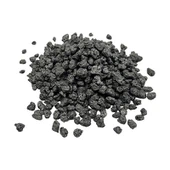
In the grand narrative of traditional steel production, carbon raisers have long played a quiet yet crucial role. As a material that increases the carbon content of molten steel, it directly impacts the strength, hardness, and process performance of steel. However, amidst the wave of Industry 4.0, this traditional material is now deeply integrating with artificial intelligence (AI) and the Internet of Things (IoT) technologies, ushering in a smart revolution in the steelmaking industry.
Challenges in Traditional Carbon Raiser Applications
In traditional electric arc furnace or converter steelmaking, the addition of carbon raisers relies on the operators' empirical judgment. A slight deviation in carbon content can result in an entire batch of steel failing to meet performance standards, leading to resource waste and increased costs. This production model, which depends on manual experience, has gradually shown its limitations in terms of quality control, efficiency improvement, and resource optimization.
Intelligent Integration: How AI and IoT are Reshaping Carbon Raiser Applications
1. Real-time Monitoring and Precise Regulation
IoT sensor networks can now achieve millisecond-level monitoring of molten steel composition, temperature, and reaction status. These real-time data streams are fed into AI analysis platforms, which use machine learning models to accurately calculate the optimal timing, type, and quantity of carbon raiser addition. For example, the system can dynamically adjust the carbon raiser ratio based on real-time fluctuations in the composition of scrap steel raw materials, controlling the carbon content error within ±0.02%.
2. Predictive Process Optimization
Algorithms based on deep learning can predict the impact of different carbon raiser schemes on the final steel performance by analyzing historical production data. After a leading steel mill introduced an AI system, the utilization rate of carbon raisers increased by 12%, while the consumption of alloy elements decreased by 8%, resulting in a dual optimization of both quality and cost.
3. Full-Process Traceability and Adaptive Learning
The entire process of each batch of carbon raisers, from warehousing to being added to molten steel, is identified and tracked by the IoT. Blockchain technology ensures the transparency of raw material quality, while the AI system continuously learns from actual production results, iteratively optimizing the addition strategy to form a self-evolving intelligent process closed-loop.
Practical Application Scenario: Intelligent Carbon Raiser Management System
In modern smart steel mills, such scenarios are becoming the norm:
- Spectral data of molten steel composition is transmitted to the cloud analysis platform in real-time.
- The AI model generates the optimal carbon raiser addition scheme within 0.5 seconds.
- Automated equipment precisely executes the addition operation while adjusting relevant process parameters.
- The entire process data is recorded and used for model training to continuously improve decision-making in the next cycle.
Future Outlook: Green Steelmaking and the Path to Carbon Neutrality
Intelligent carbon raiser management empowered by AI and IoT not only improves production efficiency but also serves as a key enabler for the green transformation of the steel industry. By minimizing raw material waste, optimizing energy consumption, and increasing the first-pass yield, the intelligent system can help steel mills reduce carbon emissions by 15 - 25%. In the future, with the improvement of carbon footprint tracking technology, the "carbon fingerprint" of each batch of steel will be clearly traceable, and intelligent carbon raiser management will be an important part of this green industrial chain.
Conclusion
The integration of carbon raisers with artificial intelligence and the Internet of Things symbolizes a broader industrial trend: the boundaries between traditional materials science and digital technology are blurring. The ancient industry of steelmaking is now gaining new vitality through "digital additives". For steel enterprises, embracing this transformation is not only a technological upgrade but also a strategic choice for future competitiveness.
In the new era of intelligent industry, the most valuable "additive" may no longer be a certain material substance, but rather digital technologies that can transform data into insights and algorithms into process advantages. The future of the steelmaking industry lies in every intelligently regulated carbon raiser particle and every line of code that optimizes production algorithms.