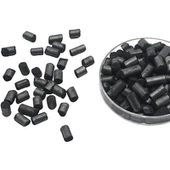
The physical and chemical specifications of petroleum coke vary depending on the production method and the final product. Some of the most common specifications for pet coke include:
Chemistry: Most petcoke consists of carbon 85~99%, and hydrogen in concentrations between 3.0- 4.0%. Raw (or green) coke contains 0.5-1% nitrogen and 0.2- 6.0% sulfur, which become emissions when coke is Calcined.
Heating Value: Petroleum coke is highly combustible and has a high heating value, often between 8,000 and 10,000 BTU/lb.
Size: The particle sizes of petcoke are typically in the range of 0-50 mm.
Ash: Depending on the origin of Petroleum coke, it may range from 0.5~1%.
Moisture: The moisture content within the Petroleum coke particles varies with the mining place; it may range from under 1% to over 10%.
Volatile Matter Content: The concentration of volatile matter in Coke varies depending on the place of mining, which is usually found in proportions of less than 10%.
Hardness: There are two distinct varieties of petcoke: calcined and uncalcined. Calcined petcoke is more complex and denser than regular petcoke due to its increased carbon concentration.
Sulfur Content: Petcoke sulfur content can vary from 0.2% to 6%, depending on the type of petcoke and the refining process used.
Metal Content: The total metal content is typically less than 0.5%. The metals in Petcoke are aluminium, cobalt, iron, chromium, calcium, and others.
Fixed Carbon: Petcoke's selected carbon content is typically more than 85% and can be as high as 99%.
Absolute Density typically ranges from 0.8 to 1.0 g/cm3.