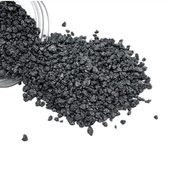
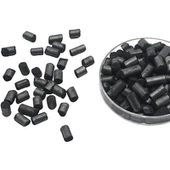
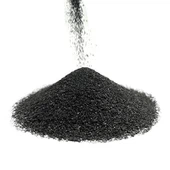
In steel casting production, artificial graphite granules serve as a crucial auxiliary material. They are widely utilized as carbon raisers (to increase the carbon content of molten iron), protective slags (to cover molten steel and prevent oxidation), casting coatings (to improve the surface quality of castings), and molding sand additives. When purchasing or using graphite granules, three specific metrics-D10, D50, and D90-invariably appear in technical reports. What does each of these represent? And why is it insufficient to rely solely on the "average particle size"? This article provides a simple, easy-to-understand explanation of these concepts.
I. What Is Particle Size Distribution?
Simply put, particle size distribution describes the "proportion of particles of various sizes" within a given batch of powder. Artificial graphite granules are not uniform; some are as fine as flour, others resemble fine sand, and a small fraction consists of slightly coarser particles. Particle size distribution is the tool used to quantify this specific composition of particle fineness and coarseness.
Typically, this distribution is visualized using a distribution curve, where the horizontal axis represents particle size and the vertical axis represents the percentage of particles. D10, D50, and D90 are three key values extracted from this specific curve.
II. What Do D10, D50, and D90 Represent?
You can easily understand these three parameters by imagining all the artificial graphite granules lined up in ascending order according to their particle size.
1. D10 - The "Fine-End Indicator"
Definition: The particle size corresponding to the point where the cumulative volume (or count) of particles reaches 10%.
Simple Interpretation: 10% of the particles are smaller than this specific size, while 90% of the particles are larger than it.
Its Role in Steel Casting:
As a Carbon Raiser: A D10 value that is too low indicates an excessive amount of fine powder. This fine powder is prone to being drawn away by the dust collection system during charging, leading to material loss and fluctuations in chemical composition; furthermore, fine powder burns too rapidly, resulting in a reduced carbon absorption rate.
2. D50 - The "Median Particle Size" (Most Commonly Used)
Definition: The particle size corresponding to the point where the cumulative volume reaches 50%.
Simple Interpretation: Half of the particles are smaller than this size, and half are larger. It can be regarded as the "average size" or the typical representative of the entire batch of particles. Role in Steel Casting:
Carbon raiser: The D50 value determines the dissolution rate of the recarburizer. If the particle size is too fine, it is prone to burn-off; conversely, if it is too coarse, dissolution will be slow or incomplete. For medium-frequency induction furnaces, Carbon raiser typically feature a D50 value ranging between 0.5 and 3 mm (500–3000 μm).
3. D90 - The "Coarse-End Indicator"
Definition: The particle size corresponding to the 90% cumulative percentile.
Simplified Interpretation: 90% of the particles are smaller than this specific size, while only 10% are larger. It serves as an upper limit indicator for the control of coarse particles.
Role in Steel Casting:
Carbon raiser: An excessively high D90 value (e.g., due to the inclusion of a small proportion of coarse particles) may result in incomplete dissolution within the molten iron, leading to residual slag inclusions and potentially compromising the quality of the final casting.