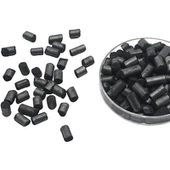
Core Differences Between Fully graphite Petroleum Coke and Semi-graphite Petroleum Coke
I. Essential Differences in Production Process and Crystal Structure
Fully graphite Petroleum Coke (GPC)
Calcined petroleum coke is sent to graphitization furnaces and processed with full-cycle electrographitization at ultra-high temperature 2500℃-2800℃. Carbon atoms fully reconstruct into neat and ordered hexagonal graphite lamellas with graphitization degree over 90%. The crystal lattice is intact and continuous without massive amorphous carbon residue.
Semi-graphite Petroleum Coke (SGPC)
It only undergoes short-cycle medium-low temperature heat treatment at 1800℃-2200℃ with insufficient power holding time. Only partial carbon crystals complete graphitization, mixed with large amounts of disordered amorphous carbon inside. Its graphitization degree stays at merely 50%-75%, acting as an intermediate transitional product between calcined coke and fully graphite coke.
II. Measured Performance Gaps of Physical and Chemical Indicators
1. Purity and Impurity Content
Fully graphite petroleum coke features fixed carbon above 99.3% and sulfur within 0.05%. Total harmful metallic impurities including vanadium, nickel and calcium are less than 30ppm, which can fully decompose and volatilize under ultra-high temperature. Semi-graphite petroleum coke only has fixed carbon of 98.0%-98.8%, sulfur ranging from 0.15% to 0.30%, 3-6 times that of fully graphite coke, and nitrogen impurities of 500-1800ppm. Insufficient heating temperature fails to deeply remove contaminants.
2. Electrical Conductivity and Compactness
The powder resistivity of fully graphite petroleum coke is only 450-550μΩ·m with true density over 2.18g/cm³ and compact regular carbon structure. Semi-graphite petroleum coke has resistivity of 800-1500μΩ·m with greatly weakened conductivity and true density of 2.08-2.13g/cm³, accompanied by more loose internal pores.
3. Volatile Matter and Thermal Stability
Volatile matter of fully graphite petroleum coke is below 0.1%, barely releasing gas under high-temperature smelting and electrolysis with outstanding thermal stability. Semi-graphite petroleum coke contains 0.4%-0.8% volatile matter and continuously precipitates gas at high temperature, easily leading to product cracking and loose pores inside castings.
4. Carbon Absorption Efficiency for Steelmaking
Neat graphite lamellas of fully graphite petroleum coke easily dissolve into molten steel with stable carbon absorption rate of 94%-96%. Semi-graphite petroleum coke mixed with massive amorphous carbon suffers severe oxidation loss at high temperature, with carbon absorption rate only 85%-90%. More raw materials are required for the same steel output.
5. Procurement Price Gap
In the market, semi-graphite petroleum coke costs 800-1300 RMB less per ton than fully graphite petroleum coke with lower short-term raw material expense, yet comprehensive downstream production losses will greatly lift overall manufacturing cost.
III. Differentiated Downstream Application Scenarios
Applicable Fields of Fully Graphite Petroleum Coke
It fits high-end production lines with strict standards on purity, power consumption and finished quality: high-current aluminum electrolytic cells above 400kA, prebaked anodes for A00 high-purity aluminum; high-grade carburizer for special stainless steel, high-strength auto structural steel and precision ductile iron; high-end carbon products including high-power graphite electrodes, lithium battery anode raw materials and industrial high-purity carbon blocks.
Applicable Fields of Semi-graphite Petroleum Coke
It is only applied to low-end working conditions with loose quality standards and priority on raw material cost control: ordinary gray cast iron, small low-standard castings; blending materials for common anodes in outdated small electrolytic cells below 300kA and mini aluminum plants; low-grade thermal insulation carbon fillers and general low-cost civil carburizer.
IV. Industrial Selection Summary
From short-term procurement perspective, semi-graphite petroleum coke has lower unit price. However, taking full-cycle costs including electricity, consumable loss, product rejection and auxiliary materials into account, fully graphite petroleum coke can cut comprehensive production cost of per ton finished product by 15%-30%, making it the long-term optimal raw material for high-purity aluminum electrolysis and high-end special metallurgy industries. Semi-graphite petroleum coke is only suitable for small and medium-sized low-end manufacturers with low product added value and loose customer requirements on impurities and performance. Large-scale high-end factories prioritize fully graphite petroleum coke for long-term production.