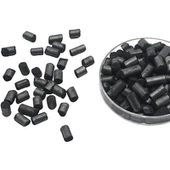
Recarburizers are divided into steelmaking recarburizers and cast iron recarburizers. Some other additives also use recarburizers, such as brake pad additives, as friction materials. Recarburizers are external steelmaking and ironmaking recarburizer raw materials. High-quality recarburizers are essential auxiliary additives for the production of high-quality steel.
In order for the carburizer to play its due role, it is necessary to choose the corresponding method according to the requirements of use and pay attention to details.
Here are two ways to use it:
1.Furnace input method:
Recarburizer is suitable for smelting in induction furnace, but its specific use varies according to process requirements.
(1) Recarburizer is used in medium frequency electric furnace smelting. It can be added to the middle and lower parts of the electric furnace according to the ratio or carbon equivalent requirements. The recovery rate can reach more than 95%;
(2) If the carbon content of molten iron is insufficient, adjust the carbon content. First, clean the slag in the furnace, then add recarburizer. The carbon is dissolved and absorbed by heating the molten iron, electromagnetic stirring or manual stirring. The recovery rate can be around 90%. If a low-temperature recarburization process is used, that is, only a part of the charge is melted, and the temperature of the molten iron is relatively low, all the recarburizer is added to the molten iron at one time, and at the same time, it is pressed into the molten iron with solid charge to prevent it from being exposed on the surface of the molten iron. This method can recarburize the molten iron by more than 1.0%.
2.Carbon increase outside the furnace:
(1) Spraying graphite powder in the ladle
Graphite powder is selected as a carbon increaser, and the injection amount is 40kg/t. It is expected that the carbon content of the molten iron will increase from 2% to 3%. As the carbon content of the molten iron gradually increases, the carbon utilization rate decreases. The temperature of the molten iron before carbon increase is 1600℃, and the average temperature after carbon increase is 1299℃. Spraying graphite powder for carbon increase generally uses nitrogen as a carrier, but under industrial production conditions, it is more convenient to use compressed air. In addition, the oxygen in the compressed air burns to produce CO. The heat of the chemical reaction can compensate for part of the temperature drop, and the reducing atmosphere of CO is conducive to improving the carbon increase effect.
(2) Using a carbon increaser during iron tapping
Graphite powder carbon increasers with a mesh size of 100-300 can be placed in the ladle, or flushed in from the iron tapping trough. After the iron is tapped, stir it thoroughly to dissolve and absorb the carbon as much as possible. The carbon recovery rate is about 50%.
The following are the precautions for using carburizer:
1.The time of adding the carburizer cannot be ignored.
If the carburizer is added too early, it is easy to attach to the bottom of the furnace, and the carburizer attached to the furnace wall is not easy to be melted into the molten iron. On the contrary, if the addition time is too late, the opportunity for carburization is lost, resulting in slow smelting and heating time. This not only delays the time for chemical composition analysis and adjustment, but also may cause harm due to excessive heating. Therefore, it is better to add the carburizer little by little during the process of adding metal charge.
If the amount added at one time is too large, it can be combined with the molten iron overheating operation used in the induction furnace to ensure that the carburizer is absorbed in the molten iron for 10 minutes. On the one hand, the electromagnetic stirring effect makes the carburizer fully diffuse and absorb to ensure the absorption effect. On the other hand, the nitrogen content brought into the carburizer can be reduced.
2. Improvement in the adding method
Do not add it all at once, add it in batches, and finally add a part after melting, put a part (about one bag) of molten iron into the bag, and then return the carburizer to the furnace for 1-2 times, then slag and add alloy.
There are several aspects that need attention:
(1) The recarburizer is difficult to absorb (uncalcined)
(2)The recarburizer has a lot of ash and the particle distribution is uneven
(3)The addition time is too late
(4)The addition method is wrong, and it should be added in layers. Avoid adding when there is too much slag on the mirror surface of the molten iron
(5)Try not to use materials with too much rust.
Different types of products require different types of carburizers according to needs. The appropriate selection of carburizers can reduce the production cost of castings.