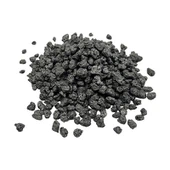
Improved Supply of Calcined Petroleum Coke Fuels Global Expansion of China's Artificial Graphite Industry
With the completion of annual maintenance of production facilities in China's carbon industry, the production capacity of calcined petroleum coke in major producing areas has been steadily released. The overall market supply has continued to recover, and the supply-demand structure has become healthier and more stable. As the most essential upstream raw material for artificial graphite products, the physicochemical stability and batch consistency of calcined petroleum coke directly determine the quality of finished graphite products, serving as a core cornerstone for the high-quality development of the entire carbon material industry.
Artificial graphite is an indispensable industrial carbon material thanks to its excellent electrical conductivity, high temperature resistance, chemical stability and high mechanical strength. Its product portfolio includes artificial graphite granules, ultrafine graphite powder, crushed graphite materials and customized graphite raw materials. Widely applied in metallurgical smelting, precision casting carburizing, electrolytic aluminum production and refractory materials, it also acts as a core raw material for artificial graphite anode materials used in new energy lithium-ion batteries. Covering both traditional heavy industry and new energy sectors, its global application scenarios keep expanding.
A unified consensus has been formed in the industry that the core quality indicators of calcined petroleum coke include sulfur content, ash content, volatile matter, true density, and trace metal impurities such as vanadium, iron and nickel. Meanwhile, particle size uniformity and concentration are also key evaluation criteria. Compared with occasional excellent test data, overseas buyers and large downstream manufacturers attach greater importance to long-term batch stability. Fluctuating raw material indicators will directly cause substandard conductivity, excessive impurities and finished product rejection, greatly increasing the production costs and quality control risks of end enterprises. Thus, a stable and controllable supply chain has become the core demand of industrial procurement.
In terms of production and processing, high-quality raw petroleum coke undergoes high-temperature calcination above 1200℃ to fully remove internal volatile matter, moisture and harmful impurities, effectively improving the true density, electrical conductivity and oxidation resistance of the product. After calcination, the raw materials go through multi-stage crushing, precision screening, magnetic iron removal, fine grinding and dust purification. At present, mainstream supplied specifications cover 0.2-2mm and 1-4mm calcined coke granules, as well as ultrafine graphite powder of various mesh sizes. Customized particle size processing is available according to customers' production processes and equipment parameters to meet diverse industrial demands.
Different end-use industries have distinct requirements for raw material indicators, making refined customized production a core industrial competitiveness. The casting and carburizing industry prefers uniform and high-purity granular materials to ensure consistent carbon content and perfect molding effects. Carbon materials for electrolytic aluminum impose strict restrictions on sulfur and metal impurities to avoid equipment corrosion and product defects. The new energy lithium battery anode sector adopts extremely stringent standards for trace elements and ash purity to prevent impurities from affecting battery cycle life and safety performance. Leading domestic carbon manufacturers accurately meet high-end procurement demands across different sectors through refined process adjustment and full-process quality monitoring.
In recent years, the global procurement logic for carbon materials has undergone a fundamental shift, moving away from the single low-price competition model. Affected by differentiated global manufacturing recovery, supply chain fluctuations and raw material price volatility, overseas enterprises engaged in metallurgy, casting, carbon processing and new energy materials have formed more rational procurement strategies. Supply chain security, quality stability and delivery timeliness have become core procurement priorities. Buyers no longer pursue low prices blindly, but comprehensively evaluate suppliers' production capacity, raw material reserve capacity, professional testing system, long-term supply reputation and cross-border delivery capability. Low-cost products with unstable indicators are gradually phased out of the market.
In terms of export business, global rigid demand for carbon materials remains strong. Overseas markets including South Asia, Southeast Asia, the Middle East and Africa maintain steady growth, becoming core export destinations for China's artificial graphite and calcined petroleum coke products. An increasing number of overseas buyers select high-quality Chinese suppliers through online research and offline factory audits, preferring source manufacturers with standardized production procedures, complete quality inspection systems and customized processing capabilities. Most clients conduct small trial orders to verify product indicators and applicability, and gradually establish long-term framework cooperation after confirming stable quality and reliable delivery. The proportion of long-term cooperative orders continues to rise.
Senior industry insiders analyze that future competition in the artificial graphite and calcined petroleum coke industry is no longer limited to price competition, but focuses on quality control, process upgrading, customized services, supply chain guarantee and cross-border delivery capabilities. To deeply explore the global market and enhance international competitiveness, domestic carbon export enterprises must abandon extensive supply modes. Based on downstream customers' actual production pain points, they need to provide one-stop customized carbon material solutions relying on mature production technology and strict quality control standards. By continuously supplying high-quality and high-stability artificial graphite and calcined petroleum coke products, Chinese carbon enterprises will further consolidate their core position in the global carbon material market.