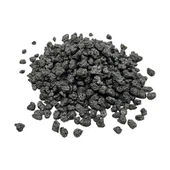
This article will provide a detailed analysis of the morphological characteristics, production processes, core application areas, and key selection points of these three types of graphite petroleum coke, helping you make accurate judgments in international procurement.
I. Quick Overview: The "Identity Labels" of Three Types of Coke
Before delving into the details, let's quickly establish a basic understanding of these three types of coke using a table:
| Comparison Dimensions | Needle Coke | Sponge Coke | Shot Coke |
| Appearance | Silver-gray, with obvious needle-like or fibrous texture, metallic luster | Dark brown, irregular shape, rough and porous surface, sponge-like | Spherical or shot-shaped, 0.6-30mm in diameter, smooth and hard surface |
| Core Value | High-end and scarce: Known as "premium coke," it is a premium carbon material | Most widely used: The most common form of petroleum coke, also known as ordinary coke | Lower value: Due to its special physical form, its industrial applications are limited |
| Main Uses | Ultra-high power graphite electrodes, lithium battery anode materials | Prebaked anodes, anode paste, carbon raisers, industrial silicon smelting | Industrial fuels such as cement plants and power plants |
II. Needle Coke Needle coke: The "Aristocrat" of Carbon Materials
1. Definition and Characteristics
Needle coke is a high-quality carbon material developed since the 1970s, belonging to the high-end variety of artificial graphite. It gets its name from the long, needle-like fibrous texture of its crushed particles. Its significant characteristics are its superior performance of "three highs and three lows": high density, high strength, high purity (low ash content), low sulfur, low metal content, and low coefficient of thermal expansion.
2. Production Process
The raw material requirements for needle coke production are extremely stringent, requiring the use of refined petroleum residue oil (such as catalytic cracking clarified oil) or coal tar pitch (with quinoline insolubles removed). Through complex processes such as delayed coking and high-temperature calcination, this coke with a highly oriented structure is finally formed.
3. Core Applications: High Value-Added Fields
Due to its excellent conductivity, thermal shock resistance, and mechanical strength, needle coke is mainly used in two high-end fields:
Ultra-high power graphite electrodes: This is an indispensable material for electric arc furnace steelmaking. Electrodes made from needle coke can shorten smelting time by 30-50% and save 10-20% of electricity.
Lithium-ion battery anode material: With the explosive growth of new energy vehicles, needle coke has become a core raw material for manufacturing high-end artificial graphite anodes, directly affecting the charge-discharge performance and lifespan of batteries.
III. Sponge Coke: The "Cornerstone" of the Carbon Industry
1. Definition and Characteristics
Sponge coke is the most common form of petroleum coke produced by delayed coking units under normal operating conditions, accounting for the vast majority of total petroleum coke production. In industry standards (NB/SH/T 0527-2019), it is what is usually referred to as ordinary petroleum coke. It has a dark brown, irregular blocky appearance, with a porous interior, resembling a sponge, hence its name. Its characteristics include high chemical reactivity and relatively low impurity content.
2. Production Process The production process of sponge coke is relatively mature and has greater adaptability to raw materials. The raw coke (containing volatiles) obtained from the coking tower is sponge coke. If used in the aluminum smelting or carbon industry, it needs to be calcined at a high temperature of around 1300℃ to become calcined coke, in order to reduce volatiles and improve its conductivity and oxidation resistance.
3. Core Applications: Intermediate Raw Material for Aluminum Industry and Carbon Products
Sponge coke is the largest-volume basic raw material used in the aluminum and carbon industries:
Prebaked anodes and anode paste: These are the "heart" components in electrolytic aluminum production, with over 70% of petroleum coke used in this field.
Carbon products: Used in the production of various carbon materials, such as ordinary power graphite electrodes and carbon raisers.
Silicon in the smelting industry: Used as a carbon source reducing agent.
IV. Shot Coke: A "Fuel" with a Unique Form
1. Definition and Characteristics
Shot coke is a type of petroleum coke with a very unique form. It is small, rounded spherical, resembling sand or small pellets, typically with a diameter between 0.6 and 30 mm. It is usually produced from high-sulfur, high-asphaltite, low-quality residual oil under specific operating conditions.
2. Why are its uses limited?
Due to its small particle size, hard structure, small surface area, and almost non-adhesive particles, shot coke has two fatal flaws:
Difficult to coke: It accumulates loosely in the coking tower, making it difficult to form large, cohesive units.
Unable to be used in electrode or carbon production: Its physical structure determines its poor bonding ability with binders, making it impossible to press or calcine into regularly shaped electrodes or anode blocks.
3. Core Application: Industrial Fuel
Due to the above characteristics, the industrial value of shot coke is greatly reduced. Its main use is as fuel in cement plants and power plants. Typical high-sulfur shot coke (e.g., sulfur content around 6%) has a high calorific value (up to 8500 kcal), but due to environmental regulations, it can only be used in specific industrial kilns with desulfurization systems.
V. How to Make the Right Choice for Your Application?
After understanding the differences between the three, the core of the purchasing decision lies in matching it to your end use. The following suggestions are for your reference:
Clearly define the end use, not just the price.
If you are an electric arc furnace steelmaking plant or a lithium battery anode material manufacturer, then needle coke is essential. Although it is the most expensive, the reduced power consumption and improved product performance it brings are irreplaceable.
If you are an electrolytic aluminum plant or a carbon raiser producer, sponge coke (calcined coke) is your most economical and mature option. You need to focus on whether its sulfur content, ash content, and trace elements (vanadium, nickel, etc.) meet industry standards.
If your purchase purpose is for fuel and your plant has complete environmental protection facilities, then low-cost shot coke is a worthwhile option to consider.
Understanding Technical Specifications
Needle coke: Focus on coefficient of thermal expansion, true density, and purity.
Sponge coke: Focus on sulfur content (low-sulfur coke <1.5% or <0.5%), ash content, and volatile matter.
Shot coke: Focus on calorific value and sulfur content (directly affecting environmental costs and equipment corrosion).
Beware of Confusion Risks
In international trade, always require suppliers to provide detailed analysis reports and clearly specify the form of coke. Low-quality shot coke can never replace high-quality sponge coke in anode production; this not only results in economic losses but may also lead to the scrapping of the entire batch of products.
Summary
Needle coke, sponge coke, and shot coke represent the high, mid, and low ends of the graphite petroleum coke quality pyramid, respectively. Needle coke wins with its superior quality, sponge coke with its wide application, and shot coke is limited by its unique characteristics.