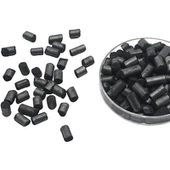
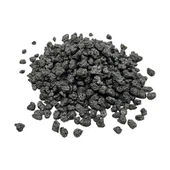
I. Ultra-high Fixed Carbon Content: >98.5%, Laying the Foundation for Carbon Additive Efficiency
The most significant advantage of graphitized petroleum coke lies in its ultra-high fixed carbon content. Data shows that high-quality graphitized petroleum coke can achieve a fixed carbon content of 98.5% to 99%, with some high-end products even exceeding 99%, placing it in a leading position among all types of carbon additives.
High carbon content means that each unit weight of carbon additive can provide more effective carbon source for molten steel, thereby significantly improving carbon additive efficiency. In contrast, the carbon content of ordinary calcined petroleum coke is typically between 95% and 98%, while that of anthracite-based carburizing agents is only 86% to 94%. During steelmaking, graphitized petroleum coke, with this core advantage, can effectively replenish the carbon elements lost during steel burning, precisely control the carbon content, and ensure that special steels and high-quality steels meet performance standards.
It is worth noting that graphitized petroleum coke does not naturally possess such high purity-it requires petroleum coke crushing and screening, calcination at 1200-1350℃ for dehydration and desulfurization, and then being charged into an Atchison furnace for high-temperature graphitization treatment at 2800-3000℃ for 48-72 hours. This process ultimately forms a highly ordered hexagonal lattice structure, increasing the fixed carbon content to over 98.5%. It is this rigorous graphitization process that results in GPC having a carbon content index far superior to other carburizing agents.
II. Ultra-Low Sulfur and Nitrogen Content: Sulfur ≤ 0.05%, Nitrogen ≤ 250 PPM, Ensuring High-End Steel Quality
In steel production, sulfur and nitrogen are harmful impurities that severely affect the mechanical properties, toughness, and weld quality of steel. After being treated at approximately 3000℃, graphitized petroleum coke significantly removes these impurities. Sulfur content is generally controlled between 0.03% and 0.05%, with high-end products reaching 0.01%-0.03%, while nitrogen content ranges from 80 to 250 PPM.
This characteristic is particularly crucial for producing high-end steel grades such as bearing steel, spring steel, and alloy structural steel. Against the backdrop of the steel industry's continued transformation towards high-end products, high-end steel has extremely stringent requirements for the sulfur and nitrogen content of carburizing agents, making graphitized petroleum coke an indispensable and preferred material. Especially in electric arc furnace (EAF) steelmaking scenarios, steel quality is extremely sensitive to impurity content. Using low-sulfur and low-nitrogen graphitized petroleum coke effectively avoids the negative impact of impurities on steel performance, ensuring stable and reliable finished product quality.
Furthermore, for special castings such as ductile iron and vermicular graphite cast iron, which are extremely sensitive to sulfur content, graphitized petroleum coke is also the preferred type of recarburizing agent.
III. High Absorption Rate and Fast Absorption Speed: >90%, Efficiency Improvement of Over 10%
Carbon absorption rate is a core indicator for evaluating the performance of recarburizing agents, directly determining production efficiency and cost control capabilities. Graphitized petroleum coke excels in this area, achieving an absorption rate of 90% to 95%. More importantly, compared to other graphitic recarburizing agents, graphitized petroleum coke has an absorption rate that is more than 10% faster.
This advantage stems from the unique molecular structure of graphitized petroleum coke-after high-temperature treatment, the carbon molecules have wider inter-molecular spacing, making it easier for them to decompose and nucleate in molten iron or steel. A high absorption rate means that less recarburizing agent is needed to achieve the target carbon content, while rapid absorption helps shorten the steelmaking cycle and improve production efficiency. While low-sulfur calcined petroleum coke has a stable absorption rate, it still lags behind graphitized petroleum coke. Calcined anthracite, on the other hand, suffers from high ash content, low absorption rate, and large fluctuations, making it unsuitable for demanding applications.
For manufacturers requiring high-carbon steel, bearing steel, spring steel, and alloy structural steel, graphitized petroleum coke offers the fastest dissolution rate and highest absorption rate, making it the optimal choice.
IV. Extremely Low Ash and Volatile Matter
: Ash ≤ 0.7%, Volatile Matter ≤ 0.8%, No Slag Return, No Pollution Graphitized petroleum coke has extremely low ash and volatile matter content, typically ≤ 0.7% ash and ≤ 0.8% volatile matter. This characteristic offers multiple practical benefits in steelmaking.
Firstly, low ash content means no additional slag or impurities are formed in the molten steel, avoiding slag return and reducing erosion of the furnace lining and the burden of slag treatment. Secondly, low volatile matter ensures that no large amounts of flue gas are generated during the addition process, which is beneficial for environmental protection and improves operating conditions in the workshop. Furthermore, the low impurity content ensures the purity of molten steel, which is crucial for producing high-quality steel, special steel, and other high-end products.
In contrast, the ash content of ordinary calcined petroleum coke is typically above 1%, while anthracite-based carburizing agents have even higher ash content. These impurities can easily contaminate the steel during the steelmaking process, affecting the quality of the finished product.
V. Excellent Electrical Conductivity and High-Temperature Stability
: Enhancing the Energy Efficiency of Electric Arc Furnace Steelmaking After graphitization treatment at temperatures above 2800℃, graphitized petroleum coke transforms from a disordered state to a highly ordered graphite crystal form, thus possessing high electrical conductivity and excellent high-temperature resistance. The resistivity of graphitized petroleum coke is generally 500-800 μΩm, significantly better than that of ordinary carbon materials.
This characteristic is of great significance in electric arc furnace steelmaking. The excellent electrical conductivity allows graphitized petroleum coke to respond quickly to electromagnetic fields in molten steel, helping to improve the heating efficiency and arc stability of the molten steel, thereby shortening smelting time and reducing power consumption. According to industry research data, using high-purity carbon additives can save 50 kWh of electricity per ton of molten steel.
Furthermore, graphitized petroleum coke possesses the ability to maintain structural integrity and physical properties at extremely high temperatures, effectively resisting thermal shock and chemical corrosion during electric arc furnace operation, and extending the service life of electrodes and furnace linings. As the steel industry accelerates its transition to electric arc furnace steelmaking, the long-term growth potential is vast-the high conductivity and high-temperature stability advantages of graphitized petroleum coke will become increasingly prominent.
VI. Controllable Particle Size and Economical Costs: Flexible Adaptation to Furnace Types, Optimal Overall Cost
Another major advantage of graphitized petroleum coke lies in its flexible and controllable particle size distribution. Manufacturers can provide products with different particle sizes according to customer needs, with common particle sizes including 1-5mm, 0.5-5mm, 2-5mm, and 0.2-1mm, and can also customize different specifications according to furnace type and application scenario. Particle size control not only affects the uniformity of addition and dissolution rate but also directly relates to carbon absorption rate-uniform particle size distribution ensures rapid dissolution and uniform distribution of carbon in molten steel, thereby improving carbon utilization efficiency.
Although the price per ton of graphitized petroleum coke is higher than other types of recarburizers, it is actually the most economical choice from the perspective of its entire life cycle and comprehensive usage costs. On the one hand, the high absorption rate means a lower amount of recarburizer per ton of molten steel; on the other hand, the low impurity content reduces the cost of slag treatment and subsequent refining; in addition, the high carbon content effectively reduces dependence on other carbon sources. For steel companies, the use of graphitized recarburizers can significantly increase the amount of scrap steel used and reduce or even eliminate the use of pig iron, thereby significantly reducing raw material costs.